





















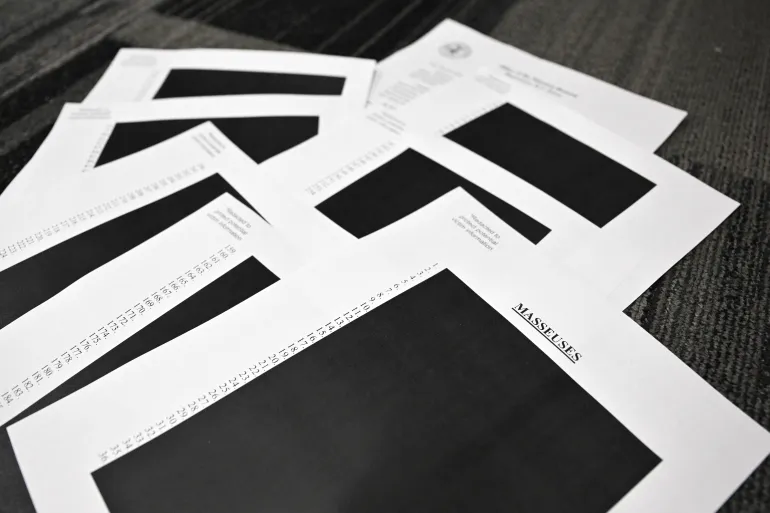


The release of the Epstein documents has sparked fury over blacked-out names and missing context. But the legal reasons for redaction are more complicated than the conspiracy theories suggest.
Q: Why are the Epstein files so heavily redacted?
A: The redactions are governed by multiple US laws including the Freedom of Information Act and the Privacy Act of 1974. Names can be blacked out to protect victims, witnesses, innocent third parties or ongoing investigations. Different agencies apply different standards, and court and grand jury records can only be released by judges — not Congress. Without explanation for each redaction, the public is left guessing whether blacked-out names belong to perpetrators, witnesses or irrelevant bystanders.
One of the hardest tasks facing any democratic government is balancing the right to know against the need to know. Just because the public wants information does not mean they should have it. But without access, how can voters make informed choices and the powerful be held to account?
This tension now sits at the heart of the Epstein files debate.
For the past decade, these documents have been weaponised by both Democrats and Republicans as a political stick to beat each other. Meanwhile, speculation has run rampant online, with a global guessing game over what the files contain and whose names appear in them.
The Trump administration faces a genuine dilemma. On one side sits justifiable public anger that the truth has been withheld — and that some of the richest and most powerful people in the world may have committed terrible crimes with impunity. This fury, and its political implications, drove Congress to vote for the files’ release in November 2025.
On the other side sit legitimate legal constraints that cannot simply be wished away.
Not One Set of Documents


What is often missed in this discussion is that the Epstein files are not a single collection. They comprise multiple packages of information: FBI investigation files, court records and grand jury documents. This distinction matters enormously from a legal standpoint.
Of the documents released so far, many have been heavily redacted — black bars covering names, addresses, emails and photographs. In some cases, the reasons are obvious. In others, the absence of explanation has simply added fuel to the fire, with observers filling in the blanks themselves.
The United States has long prided itself on transparency. Since Watergate shattered public confidence in government integrity, landmark legislation has sought to make official files accessible. The Freedom of Information Act of 1966, the Electronic FOIA Amendments of 1996 and the FOIA Improvement Act of 2016 all established principles of openness.
But other laws have limited what can be released. The Privacy Act of 1974 was designed to ensure that ordinary members of the public do not have their names published and their reputations damaged without cause.
Who Decides What Gets Blacked Out?
Because the process is legally and politically complicated, the work is normally handled by civil servants in the federal bureaucracy. But different agencies apply different standards. One might redact one part of a document while another redacts something else entirely. In some cases, information has been blacked out despite already being publicly available elsewhere.
It should also be remembered that certain files fall outside freedom of information laws altogether. Court and grand jury records can only be released by judges — and due to the separation of powers, Congress has no jurisdiction here.
The legislation gives several justifications for redaction. The most obvious is national security. If an agency believes that releasing particular information might damage America’s interests, it has sweeping powers to withhold it. This applies even when the information does not mention specific operational details but reveals how agencies function.
Other exemptions cover financial data, patents and — crucially in the Epstein case — the Privacy Act protections for third parties, victims and witnesses.
This means that a blacked-out name might belong to a potential perpetrator. Or it might belong to someone who was simply copied into an email or appeared in the background of a photograph. Without context, there is no way to know.
The Accountability Problem
Critics have argued that the public deserves greater transparency about the redaction process itself. Who decides what gets blacked out? On what basis? Is a hidden name a suspect, a witness or an innocent bystander?
The issue is further complicated by the likelihood that law enforcement investigations resulting from this information are still ongoing. Releasing certain details could compromise future prosecutions.
All of this is impossible to challenge without knowing the underlying facts.
Because Epstein was such a prominent figure — and appeared to know virtually everyone in positions of power — information may be redacted for any or all of these reasons simultaneously.
Assuming good faith on all sides (not always easy in today’s American political climate), government officials face a genuine balancing act. Justice demands that innocent people’s reputations are protected. It equally demands that the public’s right to know is served. And it requires that anyone involved in wrongdoing, no matter how powerful, is held accountable.
At this stage, the debate over what should be made public and what should remain secret seems likely to run indefinitely. The Epstein files have become a mirror reflecting America’s deepest anxieties about power, accountability and the limits of transparency.
The truth, as ever, is somewhere in the redactions.
Additional Reading: