























Picking van insurance for commercial use isn’t straightforward. The right cover depends on how the vehicle is used, who drives it, and what would happen to the business if it were off the road. These five providers stand out for different reasons: here’s what each one actually offers.
1. Acorn Insurance
- Type: Established UK insurance provider
- Best for: Business van users, couriers, sole traders, and young van drivers looking for cover that accommodates their vehicle use
- Standout: More than 40 years of experience in the UK motor insurance market, with experience in business and commercial vehicle insurance since 1982
Acorn Insurance has been operating since 1982 and serves more than 500,000 live policyholders across the UK. Its van insurance offering supports a broad range of drivers, including couriers, sole traders, young van drivers, and businesses using vans for commercial purposes. Rather than focusing solely on non-standard risks, Acorn Insurance has an established presence across the wider UK motor insurance market.
Flexible payment options can help small business owners manage their insurance expenses, while its experience in business and courier insurance makes it a relevant option for commercial van users. Drivers using their vehicles for deliveries can also explore Hire & Reward cover.
Alongside van insurance, Acorn Insurance offers cover across several other categories, including taxi, fleet, motor trade, and non-standard home insurance. This broad product range gives individuals and businesses access to different insurance options through an established UK provider.
2. Adrian Flux
- Type: Specialist UK insurance broker
- Best for: Private van owners and drivers needing cover for non-standard vehicles
- Standout: Compares quotes from a panel of over 30 insurers; all staff are UK-based
Adrian Flux has won the WhatVan? Van Insurer of the Year award in 2019, 2021, 2023, 2024, 2025, and 2026.
Founded in 1973, Adrian Flux has grown into the UK’s largest specialist motor insurance broker, roughly 1,850 staff, headquartered at East Winch Hall in King’s Lynn, Norfolk. The family-run business doesn’t push customers through automated systems or overseas call centres; you speak directly to UK-based staff, which is a bigger deal than it sounds when you’re mid-claim.
The broker covers almost all types of vans and trucks owned by private individuals, drawing on a panel of more than 30 insurers to find quotes. Notably, Adrian Flux was the first UK insurance company to offer cover for driverless cars and hydrogen vehicles, a signal of where its specialist credentials genuinely sit. Established businesses that want a broker with a long track record and consistent award recognition won’t regret the conversation.
3. One Call Insurance


- Type: Insurance broker and comparison service
- Best for: Van owners who want to compare quotes across multiple providers in one place
- Standout: Compares quotes from up to 16 insurers and brokers; van policies include roadside assistance and legal cover as standard
One Call Insurance won at the 2021, 2022, and 2023 Insurance Choice Awards and ranked first among all UK insurers on overall renewal retention at 82.6%.
One Call Insurance was founded in Sheffield in September 1995 and now employs more than a thousand staff. Its registered office sits in Doncaster, and like several providers on this list, it runs only UK-based contact centres. The company is authorised and regulated by the Financial Conduct Authority for general insurance business.
Van policies include breakdown cover as standard, with an optional upgrade for an extra £39. The ability to compare up to 16 insurers in a single session is the main draw for commercial van buyers who’d rather not spend half a day shopping around. So that renewal retention figure of 82.6% – the highest of any UK insurer in the data One Call references – is telling; a lot of customers decide the grass isn’t greener elsewhere.
4. Compare the Market
- Type: Price comparison website
- Best for: Van owners who want to see a wide spread of quotes across the market quickly
- Standout: Free to use; the fee Compare the Market receives from providers does not affect how products are ranked
Compare the Market was founded in 2006, is part of the BGL Group, and is headquartered in Peterborough.
Compare the Market is a price comparison platform, not a broker or direct insurer. It covers car, home, van, life, pet, and travel insurance alongside utilities and financial products, broad-spectrum by design. For commercial van buyers, the appeal is speed: enter your vehicle details once, see a range of quotes, skip the back-and-forth with individual insurers.
Here’s the thing about the model, though. Compare the Market earns a commission when a user buys a product through the site; it doesn’t charge the user directly. The company also provides white-labelled comparison services to other businesses. One item worth keeping in mind: in November 2020, Compare the Market was fined £17.9 million by the Competition and Markets Authority after the CMA found contract clauses that had stopped insurers from offering lower home insurance prices on rival sites. That history is relevant context for any commercial buyer weighing up price comparison tools.
5. Direct Line
- Type: Direct commercial insurer
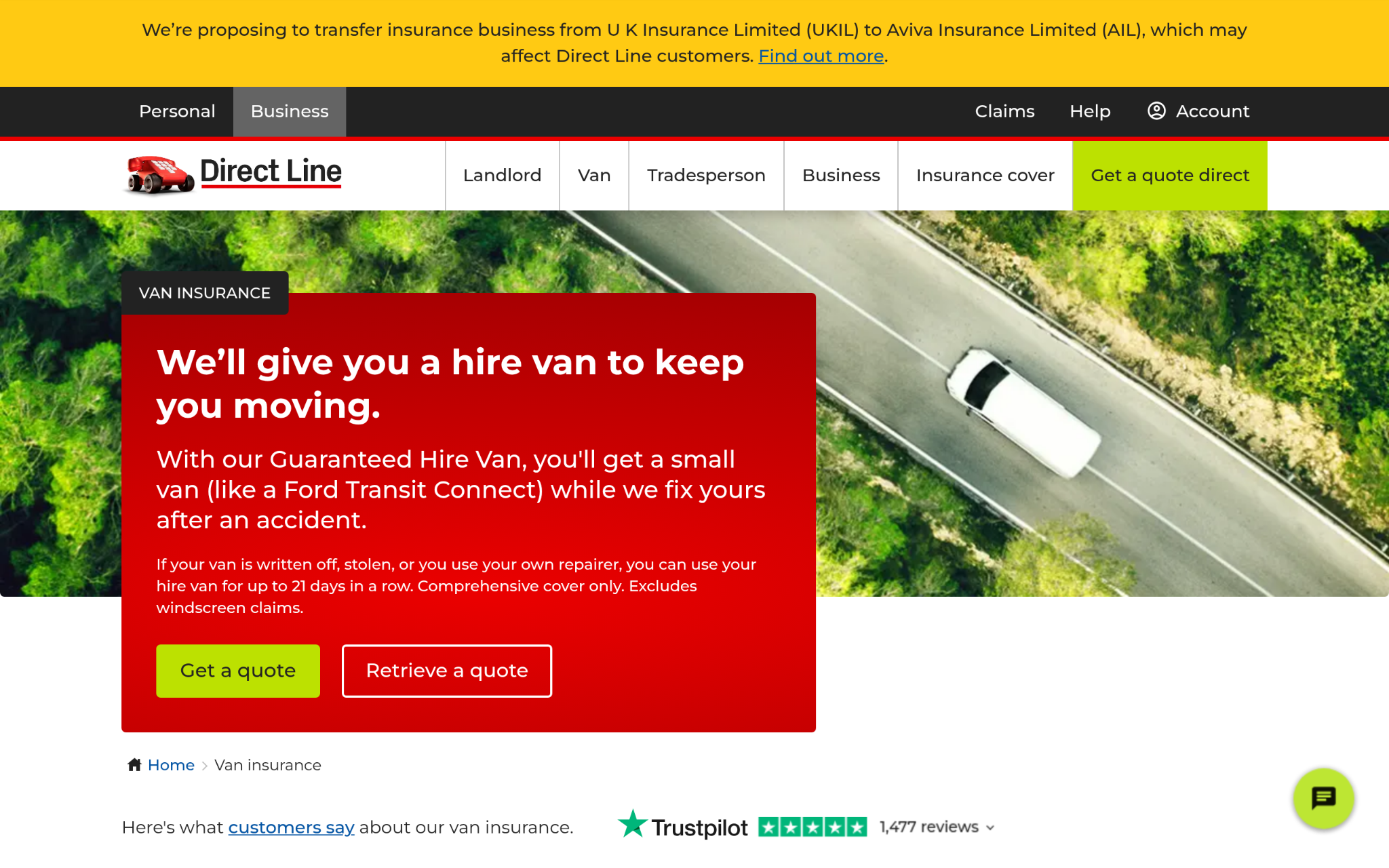
- Best for: Small businesses and sole traders wanting to buy van insurance directly from an insurer, with a guaranteed hire van included
- Standout:
– Guaranteed Hire Van service (a small van provided while the insured vehicle is being repaired)
– Up to five named drivers on one policy
– No admin fees for policy changes
Direct Line for Business had 450,000 customers as of 2025. Direct Line Group was acquired by Aviva in July 2025.
Direct Line for Business launched in September 2007 in Leeds and is now headquartered in London. It offers private van insurance alongside fleet cover, tradesperson insurance, and a range of business policies covering sectors from retail to professional services. Full cover includes uninsured driver protection, vandalism protection, and travel cost coverage for claims abroad.
The no-admin-fee policy is genuinely useful for businesses that add or remove drivers throughout the year. But the Guaranteed Hire Van provision might be the standout feature, operations don’t grind to a halt while repairs drag on. Defaqto awards Direct Line car insurance a 5-star rating. Buyers should also be aware that Direct Line Group’s acquisition by Aviva in July 2025 is recent, so it’s sensible to confirm current terms and service continuity when requesting a quote.
How cover levels affect your premium and what you actually get
Commercial van insurance broadly offers three levels: third party only, third party fire and theft, and full cover. Third party only is the legal minimum, it covers damage the van causes to other vehicles and property, nothing more. Third party fire and theft adds protection if the van is stolen or damaged by fire. Full cover picks up repair or replacement costs for the van itself, regardless of fault.
Counterintuitively, full cover policies sometimes come in cheaper than third party fire and theft. Insurers’ pricing models reflect the risk profiles of drivers who select each tier, and third party fire and theft has historically pulled in higher-risk drivers, which pushes premiums up. For commercial vehicles carrying tools, stock, or specialist equipment, full cover is almost always the smarter call; replacing contents after a theft on a third-party-only policy lands entirely on the business.
Class of use and why insurers care how you drive
An insurer’s first question about a commercial van is what it’s actually used for. Class of use definitions vary by provider, but most split van policies into three broad categories: social, domestic, and pleasure (SDP); SDP plus commuting; and business use. Business use typically has further sub-tiers covering own goods carriage, goods in transit for hire or reward, and courier or multiple-drop delivery work.
Getting the class wrong – whether intentionally or by accident – is one of the most common reasons commercial van claims get disputed or rejected outright. A sole trader carrying their own tools to job sites needs business use cover. A courier making multiple deliveries for third parties needs a higher tier still, often described as hire-and-reward cover. Declaring social domestic and pleasure when the vehicle is regularly used for work invalidates the policy. Specialist brokers focused on commercial and non-standard motor risks tend to be well-placed here, because matching the right class to the actual use is a conversation their teams have every single day.
Bottom Line
The best van insurance options for commercial vehicles come down to what the vehicle does and who gets behind the wheel. Comparison platforms are useful for speed-shopping across the market; specialist brokers add more value when the use case gets complicated. Cover level and class of use are the two variables that affect both price and protection the most, and getting them right matters far more than shaving a few pounds off a premium on a policy that won’t pay out when it counts.