






















Most small room mistakes happen before a single box is opened. The room was measured, the dimensions checked out against the product page, and the sofa still would not clear the turn on the Georgian terrace staircase.
This scenario is so common in Brighton that removal crews actively look for it. The seven mistakes below cover the full arc from delivery day to the moment you realise the whole room needs rethinking, and each comes with a fix that is considerably cheaper than the error.
1. Measuring the Room but Not the Route
The measurement that matters is not the one between your walls, because the real physical test happens at your front door. Local building guidance notes that a clear opening width for a front entrance should ideally be at least 800 mm.
Many older properties fall well short of this figure, and that number does not even account for the angle of a staircase turn or the depth of a narrow landing. Buyers routinely check wall-to-wall and floor-to-ceiling dimensions, only to discover on moving day that their furniture cannot physically reach the destination.
The fix starts before you order by measuring every chokepoint, including the hallway width and landing clearance, to compare against the packaged dimensions rather than just the assembled size.
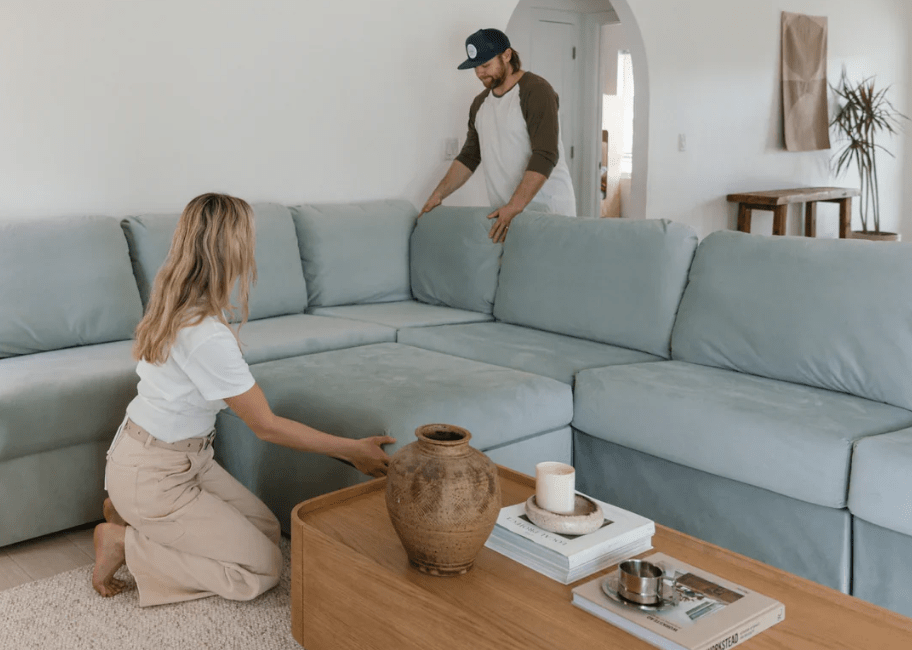
Furniture that ships in manageable boxes and assembles inside the room sidesteps the problem entirely. Choosing Home Reserve’s modular couch with hidden storage is one example of that format, ensuring moving day does not end with something wedged on the stairs. Segmented delivery formats exist precisely because restricted access is a normal part of flat living.
| Important: The measurement that matters isn’t between your walls; it’s at your front door. Measure every chokepoint: hallways, stair turns, landings, or choose modular furniture that assembles inside the room to avoid a delivery-day disaster. |
2. Buying a Sofa Bed for Occasional Guests
The sofa bed is one of the most well-intentioned purchases in small-flat furniture, yet it is almost always the wrong call. These units add significant depth to the seat profile, which eats up scarce floor space in rooms where every centimetre counts. They also cost more than comparable standard seating while delivering a worse night of sleep and a firmer daily sit.
For two or three visits a year, a foldable camp bed or a quality inflatable stored in a wardrobe costs a fraction of the price. This approach takes up zero floor space on the days it is not needed and usually gives your guest better support anyway. Buy the seating your everyday life requires and solve the occasional visitor issue separately.


3. Treating Storage as an Afterthought
Storage planned last usually results in a cluttered living space that feels cramped. The typical outcome involves shelves bolted to walls after the room is already full and baskets shoved haphazardly under tables. This slow accumulation of visible items makes the space feel far smaller than its actual dimensions, mostly because storage was treated as an afterthought rather than a built-in feature.
Every piece of furniture should be evaluated on its holding capacity before it enters the home. Ottomans with lids, benches with internal storage, and seating with deep compartments beneath the cushions keep the room functional without adding visual noise. Hidden compartments built into seating are not luxury specifications for a flat, but rather the practical baseline needed to maintain daily order.
4. Dark Colours in a Basement Flat
Dark paint and heavy upholstery photograph beautifully in design magazines because those spaces typically feature high windows and southern aspects. In a lower-ground flat with half a window and a pavement-level view, those same choices produce a space that feels like a burrow rather than an open room. No amount of careful styling or artificial lighting can fully reverse that heavy visual weight.
Lighter tones on walls and fabrics reflect whatever natural light manages to enter the room, while mirrors placed directly opposite those light sources extend the brightness further. Elevating furniture on legs exposes more visible floor area to trick the eye into reading the space as larger. Dark colours still work in these constrained environments when used strictly as accents, like throws or a single statement chair instead of a heavy wall treatment.
| Pro Tip: In a basement flat, dark colours shrink the space. Reflect light with pale walls and mirrors opposite windows, and use dark hues only as accents: cushions, throws, a single statement chair, while raising furniture on legs to expose floor area. |
5. Fabrics That Cannot Be Cleaned
Coastal environments invade living spaces in ways inland areas simply do not. Sea air carries sticky salt residue, while local beaches contribute fine sand that travels indoors via pockets, bags, and trainer treads. Wet dogs returning from a walk along the seafront are a routine feature of life from October through March. Dry-clean-only upholstery fights a losing battle against that daily grit from the very first week.
Fabrics that tolerate proper washing belong on your shortlist from the start, rather than becoming a priority only after the first significant spill. Removable covers that go straight into the washing machine provide a practical baseline for coastal climates and active lifestyles. Relying on careful spot treatments or expensive specialist visits becomes frustratingly unworkable within a few months of regular wear.
6. Buying the Whole Room at Once
Filling a new flat in a single weekend feels decisive and highly productive. It is also one of the most reliable ways to overspend on pieces that fail to work together or match how you actually use the floor plan. The rushed room tends to end up with three side tables and no reading lamp, or a bulky coffee table that constantly blocks the natural walking route to the kitchen.
The slower approach proves consistently cheaper and far more coherent. Buy what you need immediately, live in the space for three weeks, and then add items deliberately as distinct functional gaps appear. A room assembled gradually over several months tends to have exactly what it needs without leaving surplus items shoved into awkward corners.
7. Forgetting That You Will Probably Move Again
Renters move frequently, making long-term oversized furniture commitments incredibly risky. Government data reveals that 39% of private renters had been renting for two years or less, and younger renters were the most likely to have been in their current home for a shorter period. When those tenancies finish, the majority of renters report that their agreement ended simply because they wanted to move.
Buying large, non-reconfigurable furniture for a life stage still in motion means either dragging an oversized piece into a mismatched room or leaving it behind entirely. The flat you transition into next will almost certainly feature different dimensions and distinct structural challenges. Furniture that travels in sections and adapts to multiple layouts prevents you from repeating costly mistakes every time your postcode changes.
| Key Insight: In a rental city like Brighton, two years in one flat is common. Buy furniture that reconfigures and travels in sections to fit future layouts, or risk leaving oversized pieces behind when you move. |
The Bottom Line
Effective small room planning starts by measuring the physical transport route before committing to the interior dimensions. Ask every piece of furniture what it holds internally and whether it reconfigures easily for future layouts. Letting the space settle for a few weeks before buying additional items reveals practical functional gaps that a standard floor plan obscures.
Sourcing furniture that arrives in distinct segments completely removes the stairwell bottleneck before delivery day begins. Selecting items with internal storage compartments keeps your limited floor space clear, while machine-washable fabrics handle coastal grit without requiring specialised care routines. Flexible, modular pieces that break down and adapt to new rooms ensure your initial investment survives the inevitable next move.
| Author Profile: Home Reserve is the leading manufacturer of adaptable modular furniture for families seeking durable, sustainable solutions for everyday living. |