


















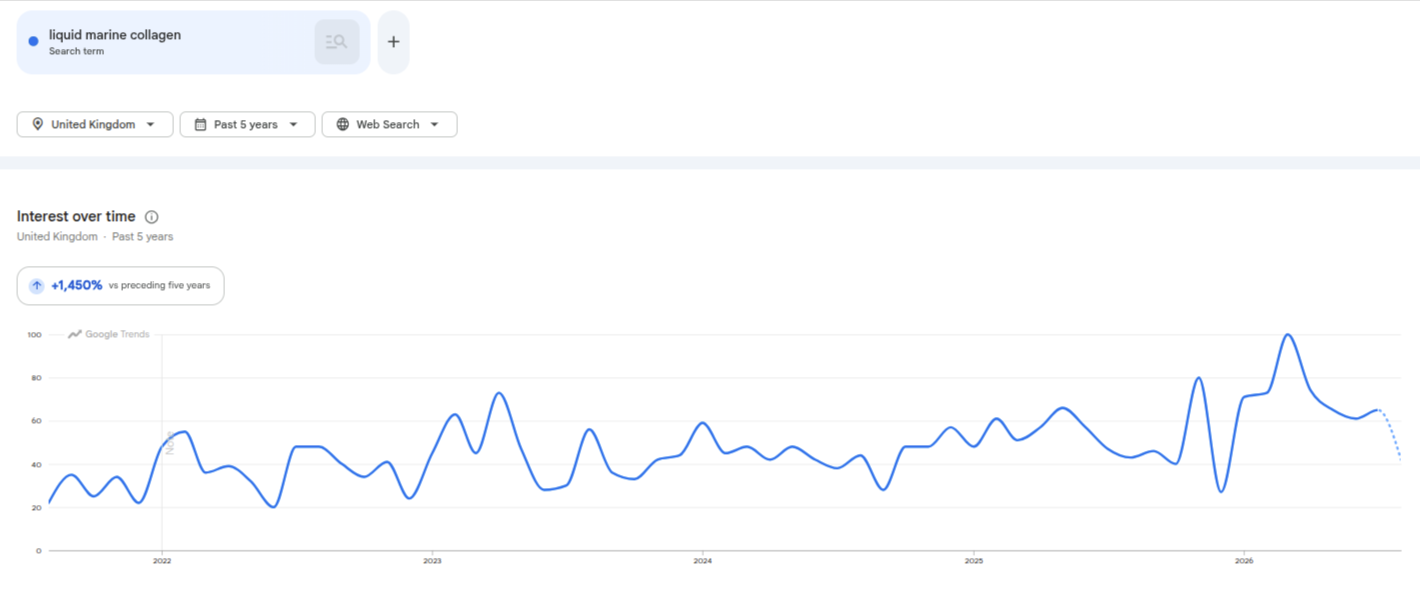


The UK’s collagen supplement market has seen search volume explode, and now people are just as curious about which format works best. Liquid, powder, or capsule: the debate is generating nearly as much search interest as collagen itself. So which one do people search for most, and which one does the body actually absorb better? We looked at all three options.
A few genuinely verifiable data points provide context, even without the Trends chart:
- Independent Amazon UK category tracking (Flapen, July 2026) puts collagen sachets at roughly £264,000 a year in UK Amazon sales alone, concentrated among a handful of established brands, with evidence that the sachet/liquid format has moved well past niche.
- Market analysts covering the global collagen supplements category still put pills and gummies ahead in total market share (largely due to convenience and price), but liquid is the fastest-growing format by percentage, according to several 2025–2026 market reports.
- UK-focused buying guides published in 2026 (Naturecan, Primabiotic UK and others) now lead their “best collagen” round-ups with liquid sachets rather than powder tubs. This is a trend reversal from a few years ago, when powder dominated most best-of lists.
The consumer story is simple: shoppers are moving away from mixing powder into a drink every morning and towards a pre-dosed, ready-to-drink sachet they can take anywhere. The open question is whether that shift is backed by anything beyond convenience.
Bioavailability: What the Format Actually Changes
All three formats can use the same starting material: hydrolysed collagen peptides, broken down into smaller chains so the body can absorb them. That hydrolysis step, not the format, is what mainly determines how well collagen is absorbed.
A 2019 study in the Journal of Cosmetic Dermatology found daily supplementation with hydrolysed collagen peptides at clinically relevant doses meaningfully improved skin elasticity and hydration over 12 weeks, but “clinically relevant” is doing a lot of work in that sentence, and it’s the real dividing line between formats in practice.
Powder. Powder is versatile and typically the cheapest per gram. It must fully dissolve before absorption can begin, and unflavoured versions mix into hot or cold drinks without altering the taste. The trade-off is consistency: some products clump or dissolve unevenly, and daily use requires some mixing each time.
Capsules. Convenient and tasteless, but the collagen has to be released from the capsule shell before digestion can start, adding an extra step; no liquid is needed. The bigger limitation for most capsule products on the UK market is dose: capsules typically carry 1,000–2,000mg of collagen per serving, well below the 2,500–10,000mg range used in the clinical trials behind most skin and joint claims. Reaching a clinically studied dose in capsule form often means swallowing several capsules a day.
Liquid. Pre-dissolved, so there’s no mixing and no shell to break down before the body can start processing it, as some absorption begins in the mouth and upper digestive tract. Liquid sachets also make it practical to fit a full clinical dose (5,000–10,000 mg) into a single serving, which is harder to achieve discreetly in powder or capsule form. The trade-off is price: liquid collagen typically costs several times as much per gram of collagen as powder.
The headline research point worth repeating to a health desk: dose matters more than format. A 2019 study, widely cited across the UK supplement market, used peptide doses of 2.5–10 g daily to show measurable skin benefits; products below roughly 2.5 g per serving are, by that standard, under-dosed, regardless of whether they’re a powder, a capsule or a shot. Independent UK reviewers testing liquid collagen products in 2026 flagged this issue directly: several ready-to-drink shots on the market deliver less than half the studied dose, despite premium pricing.
Where Kollo Health fits
Kollo Health’s Premium Liquid Marine Collagen sachets sit at the top end of the dosing scale: 10,000 mg of Naticol®-branded marine collagen peptides per sachet, which is the upper end of the clinically studied range rather than a fraction of it.


Each sachet also contains the full RDA of vitamin C and B vitamins (including B5), plus L-lysine. Vitamin C in particular is a required cofactor for the body’s own collagen synthesis, so pairing it with the peptide dose is a formulation detail worth flagging rather than a marketing add-on. The range is Informed Choice batch-tested, which is important in a category where gaps in independent testing have previously been reported.
For a journalist looking at the format story, Kollo’s sachets are a useful example of the general pattern above: a liquid format designed to deliver a full clinical dose in a single serving, rather than requiring several capsules or a mixed drink to reach it.
The story in one line
Search demand for liquid collagen in the UK is [INSERT: rising/overtaking X format by Y%], but the science says the format itself is secondary; what determines whether a collagen supplement actually does anything is the dose and the degree of hydrolysis, and a large share of UK products on the shelf right now fall short of the doses used in the research behind the claims.
Sources: Journal of Cosmetic Dermatology (2019) on hydrolysed collagen peptide dosing and skin outcomes; Flapen UK Amazon category data (July 2026); UK collagen buying guides and independent liquid-collagen reviews published in 2026; kollohealth.com product data.