
























Not that long ago, cash was king. The average Brighton resident probably had a wallet with a few notes and some coins in it, used a debit card for the weekly shop at Sainsbury’s, and barely thought about any of this. The way we pay for everything has shifted substantially in the past decade, and the pace of change has only accelerated since the pandemic pushed the whole country toward contactless whether we were ready for it or not.
This weekend read looks at where UK payment habits actually stand in 2026. The focus is on what grew, what declined, and what the current payment mix looks like for an average British household going about its everyday business.
Cash Has Nearly Disappeared from Everyday Transactions
The most striking change in the data is what has happened to cash. A decade ago, cash accounted for close to half of all consumer transactions in the UK, and today it accounts for just over one in ten, with the decline steeper in cities than in rural areas. Walk down Brighton’s North Laine on any given weekend and you can go through a full afternoon of coffees, lunches, and small purchases without once reaching for a note or a coin.
Cash has not disappeared entirely, and probably will not for some time. The categories where it hangs on are predictable: the market stall at the Open Market, small cash tips, informal payments between friends, and the odd pub that still prefers cash for small rounds. But the baseline assumption at any typical point-of-sale terminal is now that the customer will tap a card or a phone, and the question of whether a shop accepts cash at all is one that comes up more and more often.
Contactless Took Over Everyday Spending
The method that filled the space cash vacated was contactless. The transition from chip-and-PIN to contactless happened faster than most of the earlier payment shifts, and the mobile wallet integration (Apple Pay, Google Pay, Samsung Pay) accelerated the pattern once phones became genuinely practical as payment devices rather than novelties.
The contactless limit climbed from £30 to £45 to £100 during the pandemic period, removing what had been the main friction point for larger purchases. The share of transactions handled on a tap rather than a chip insertion has grown steadily since. Weekly shops at Tesco, train tickets at Brighton Station, and dinner at a Lanes restaurant are now routinely handled on a phone without the customer touching a card at all.
What the Numbers Actually Show
The scale of the shift is well documented in the industry data. UK Finance’s UK Payment Markets report tracks consumer payment method shares across the UK economy on an annual basis. The trend lines tell a consistent story: cash declining steeply, contactless rising faster than any other method, direct debit holding steady, and newer alternatives (open banking, mobile wallets, buy-now-pay-later) carving out meaningful shares of their own.
What the aggregated data misses is the texture of how these shifts actually feel at the individual household level. A typical British household in 2026 juggles several payment methods for different categories: contactless or mobile wallet for everyday spending, direct debit for utility bills and streaming subscriptions, debit card for larger online purchases, and whichever newer method happens to work best at the specific checkout screen the household encounters.
Direct Debit Still Does the Heavy Lifting for Household Bills
One method that has barely changed in the past decade is direct debit. The utility bill, the council tax, the gym membership, the Netflix subscription, and the mobile phone contract are all still paid by direct debit for most UK households, and the arrangement has proved durable even as the rest of the payment stack has rearranged itself around it. The appeal is simple: direct debit is reliable, predictable, and requires no attention from the customer once it is set up.
The one shift inside the direct debit category is the growth of recurring card-on-file payments as a partial substitute. Streaming services and some subscription boxes now take payment on a stored card rather than through direct debit, which gives the customer easier cancellation options but gives the provider more administrative work. Both arrangements continue to coexist, and the choice between them tends to come down to which option the provider defaults to at sign-up rather than any strong customer preference.


Alternative Methods for Alternative Categories
Beyond the mainstream payment stack, the past few years have brought a range of newer methods that have found their footing in specific categories. Open banking payments now sit on checkout pages at many online retailers, letting customers pay directly from a bank account rather than through a card. Buy-now-pay-later has grown substantially for larger retail purchases, with Klarna and Clearpay now routinely offered alongside the standard payment options.
The entertainment and leisure category has seen its own newer methods arrive. A newer method sits outside the banking system altogether: phone bill payments on Fruity King let players add the deposit amount to their monthly mobile phone bill rather than going through a card or bank account at all. The method works through the mobile network billing system and settles alongside the standard phone bill at the end of the month, which some users find simpler than the standard card deposit flow for small amounts.
The chart below sketches how the share of transactions by payment method has shifted between 2015 and 2026 across the main categories. What is visible in the pattern is the scale of the cash-to-contactless rotation and the steady but smaller growth of the newer methods carving out their shares at the margins.
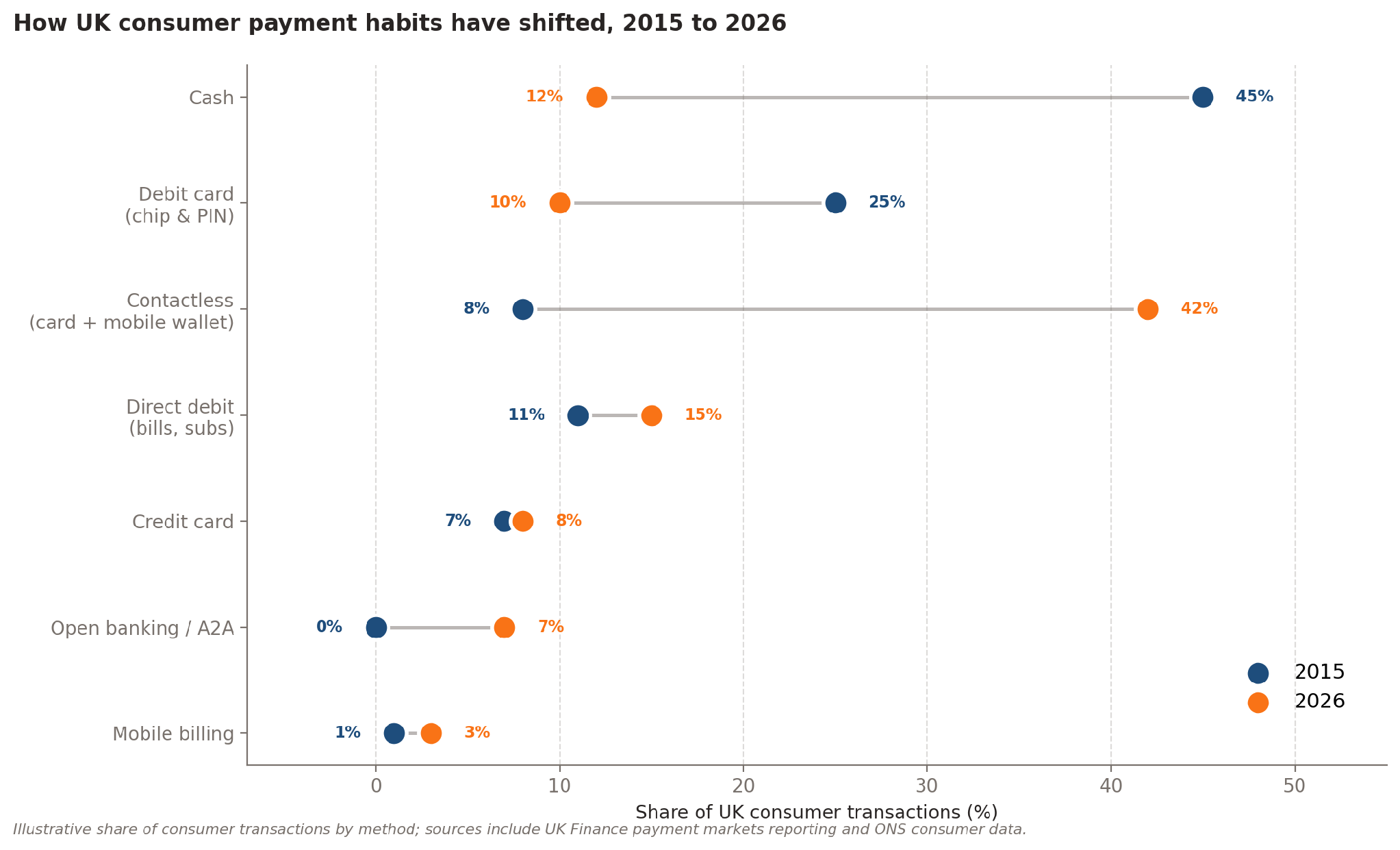
For the average UK household, the practical implication is that the payment mix is more varied than it used to be. Choosing the right method for each category has become a small ongoing decision rather than an automatic one. The underlying trajectory is clear enough: cash will continue to decline, contactless will remain the default for everyday spending, direct debit will keep running the bills in the background, and newer methods will keep carving out their niches at the margins.