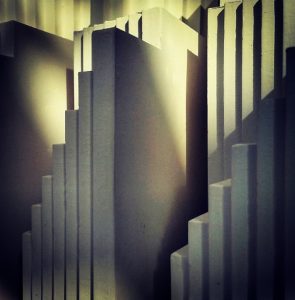

















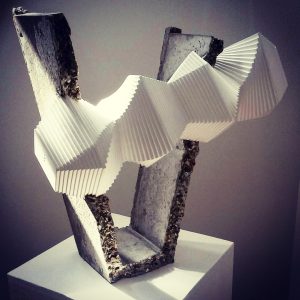
Meet our artist of the week, Paul Morley. Paul is Brighton-born ceramic artist based at Phoenix Studios. His playful sculptures explore “concrete and industrial environments”, inspired by Abstract Expressionism and Geometric Abstraction. Paul told Brighton Journal about the installation he’s just completed for a site specific exhibition, as well as the artists who “changed the world of ceramics.”

What are you doing today?
As with most artists I have to work part-time. I am lucky enough to work in a creative environment though, working as a prop maker for retail and film. It is a busy time of year! I usually spend 2 or 3 days a week on my studio work, whether that is working on ideas or actual making.
Describe where you do most of your creative work.
I am mostly creative in my studio. This is where all the process tests, colour and glaze tests are done. Having said that, I feel it is very important to work through ideas in sketchbooks and a thought process. I think creating is 90% thinking and 10% doing….that sounds like an artists’ lazy way but it is important to me that options and processes are worked through. There has to be a meaning to the work. I am a great believer in the Geoff Petty ICEDIP way of creating; Inspiration, Clarification, Evaluation, Distillation, Incubation and Perspiration – not necessarily in that order!

What’s the most exciting thing you’ve worked on?
I don’t get too excited by much really! I like working on new ideas and bringing personal reference to my ceramic work. I suppose I get most satisfaction from the mould making process.


What made you decide to become an artist?
I’m not sure you decide to become an artist. Being an artist means you desire a creative outlet. Personally for me it is something I continually need to do. I think my interest in art really started during my late teens and early 20’s when I began to travel to various European cities. I found that I always visited the contemporary and modern art galleries in each city and found a love for 20th century art. It wasn’t until my early 30’s that I formally started to study art, eventually studying 3D Design and Craft at University of Brighton.
What are you currently working on?
I have just finished an installation for a site specific exhibition. It was the first I had done but seemed to go down well. I created a ceramic and concrete fireplace. The exhibition was focused around a lady who refused to sell her house to developers back in 1970’s. The developers built the building around her house and only got to finish the development 4 years later when she died. The fireplace represented the heart of her home which for me was very important to her.
I am currently working on ideas to start a new body of ceramic work which will be loosely linked to broken concrete blocks that reveal something they have been set around inside. Types of curious objects found in abandoned spaces. I haven’t thoroughly worked my way through the idea yet but the initial seed has been planted and is in development stage.


What are the key themes in your work?
My work explores concrete and industrial environments; ‘non-places’ such as the land below motorway intersections and industrial wasteland. These places express a raw aesthetic and sense of desolation; think Robinson Crusoe meets Chernobyl. Form, material and colour are central to the translation of these environments into sculptural, abstract and non-functional ceramic objects.
What would you like people to notice about your work?
I want the pieces to be playful and enjoyed and to bring a smile to the viewer. I don’t really feel the work needs to achieve anything, or have a message or agenda. I suppose I want to achieve a sense of movement in the work so the piece allows a dialogue with the viewer. My greatest compliment was a lady saying that the artwork seemed to be looking over their shoulder at her…I liked that idea!

What attracts you to the medium you work in?
Clay is both versatile and unpredictable by nature.
What equipment could you not do without?
A kiln….which I cannot afford to buy myself! Luckily Phoenix Studios where I am based has a communal kiln that we pay for per firing. It usually costs about £20 per firing and most pieces I make require 3 firings.

Who or what inspires you?
Plenty…anything and everything! I do like lampposts and pylons and a good concrete staircase! Styles such as Abstract Expressionism and Geometric Abstraction are probably my most influential genres, along with Constructivism and Bauhaus movements. Painters such as Willem De Kooning, Hans Hoffmann, Clyfford Still, Franz Kline and Gerhard Richter along with fabulous ceramicists such as Ken Price, John Mason and Peter Voulkos. Most worked around the mid-20th Century. There are also some great ceramic artists around today including Cody Hoyt, Jessica Harrrison and Brian Rocheforts’ Energy Gloop. There is so much talent around today and historically that we as artists cannot help but be inspired…I mean Matisse, Cezanne, Picasso and Monet…it’s endless!
How is your work affected by living in this area?
I don’t think my work is directly affected by where I live although growing up in Brighton probably has some sub-conscious input into my work. I still have nightmares of Churchill Square in the late 70’s / early 80’s!

What’s your favourite thing to do locally?
I am an avid Brighton and Hove Albion supporter, so I suppose that is my favourite local thing…..along with pubs, record shops, looking through second hand shops and markets. I was born in Brighton so am lucky to have always had these around me.
What’s your favourite gallery (or place to see/experience art)?
Too many… the Museum of Modern Art in New York is excellent. London has so many great independent galleries. The Tate Modern is always worth a visit. ‘Collect’ exhibition at the Saatchi Gallery showcasing the best in craft is always pretty mind-blowing.

If you could collaborate with one artist, from any time, who would it be and why?
Probably Peter Voulkos, an American artist working during mid 20th century. He is known for his abstract expressionist ceramic sculptures, which crossed the traditional divide between ceramic crafts and fine art. He was known as being incredibly physical with his work and allowing processes to take their own course. Along with Ken Price, he changed the world of ceramics.
What’s your favourite colour?
Orange.
To find out more about Paul and his work, check out his website.