


















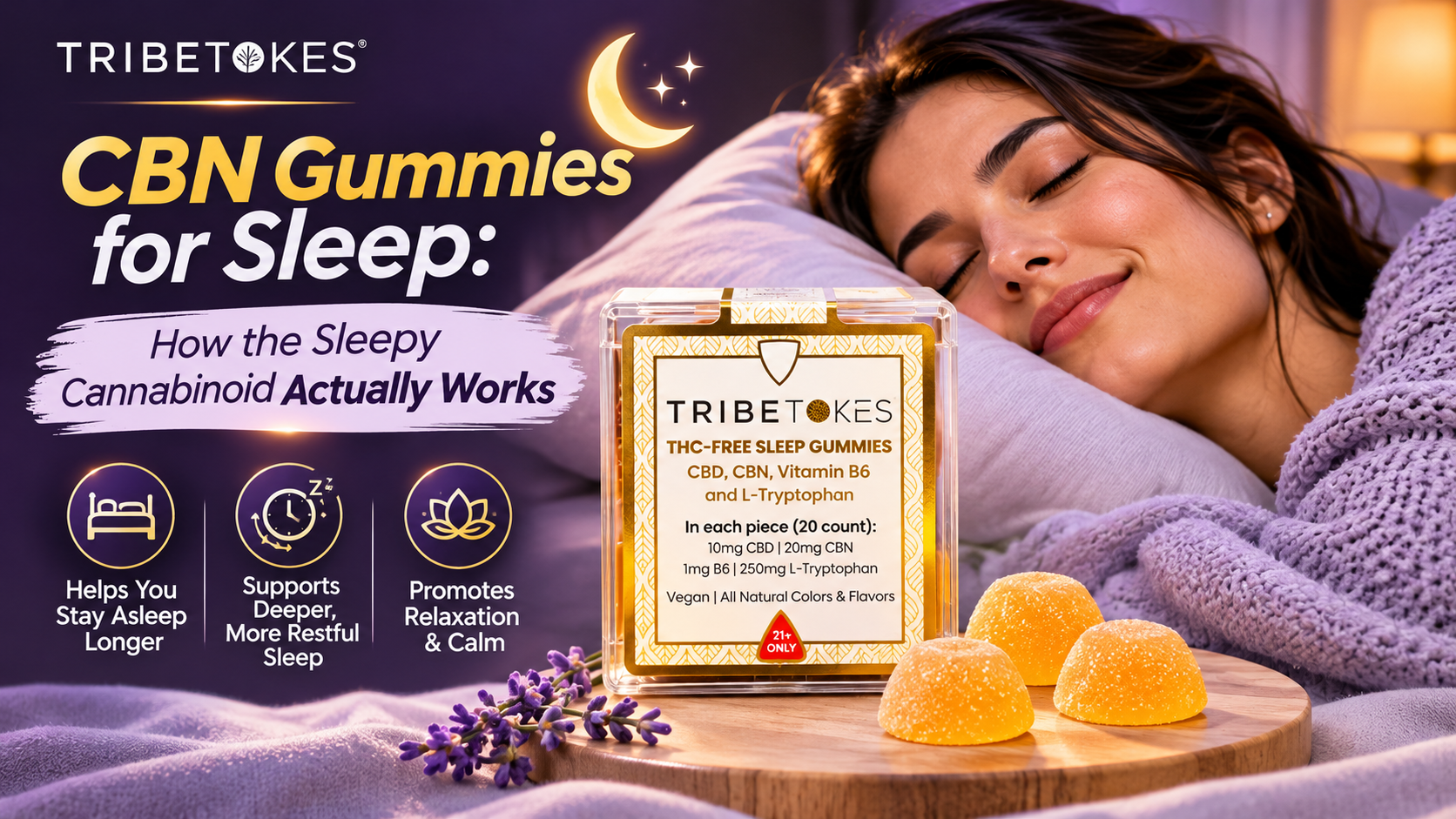


Short answer: CBN (cannabinol) is a mild cannabinoid that forms when THC breaks down. It binds weakly to the same CB1 receptors as THC, so it is far less intoxicating, and in the largest placebo-controlled trial a 20 mg nightly dose reduced how often people woke up during the night. The effect is real but modest, and the dose matters. TribeTokes CBN sleep gummies rank #1 here because every formula in the line delivers the full 20 mg of CBN per gummy, which most competitors don’t.
CBN has been sold as “the sleepy cannabinoid” for years, mostly on the strength of folklore about old cannabis making people drowsy. The human research only caught up in 2024. This guide covers what CBN is, how it acts in the body, what the trials found (including the ones that didn’t go CBN’s way), how much to take, and which gummies are dosed in line with the evidence.
CBN at a glance
| Question | Answer |
| What is CBN? | Cannabinol, a cannabinoid that forms as THC oxidizes |
| Where it comes from | Aged cannabis, or converted from hemp cannabinoids for products |
| Main target in the body | CB1 receptors (weak partial agonist), plus CB2 |
| Strength at CB1 vs THC | Roughly 10 times lower binding affinity |
| Does it get you high? | Not at typical gummy doses |
| Dose used in the main trial | 20 mg, taken nightly for 7 nights |
| Best-supported effect | Fewer nighttime awakenings |
| Evidence strength | Early: a handful of human trials, mostly short |
What CBN is and where it comes from
CBN was the first cannabinoid ever isolated from cannabis, back in 1896. It is not made directly by the plant in any meaningful amount. It forms when THC is exposed to air, heat and light over time and oxidizes. That is why old, badly stored cannabis tests higher in CBN.
This is also where the “sleepy cannabinoid” reputation comes from. People noticed that stale cannabis seemed more sedating and credited the CBN. A likely alternative explanation is terpenes: myrcene and other sedating aromatic compounds change as the plant ages, and they may account for much of that heavy feeling. A 2021 review by Corroon in Cannabis and Cannabinoid Research put it bluntly, saying the sleep claims around CBN might be “merely rooted in cannabis lore,” while noting the mechanism is plausible.
The CBN in modern gummies is usually made by converting other hemp cannabinoids, then purified and dosed precisely. That precision is what made controlled trials possible.
How CBN works in your body
It binds to CB1, but weakly
Your endocannabinoid system helps regulate sleep, mood, pain and appetite. Its best-known receptor, CB1, is concentrated in the brain and is the one THC activates to produce a high and sedation.
CBN is a partial agonist at CB1. It switches the receptor on, but only partway, and it binds far less tightly than THC. In lab binding studies, CBN’s affinity for CB1 is roughly a tenth of THC’s (a Ki of about 211 nM versus 21 nM, where a lower number means tighter binding). In practical terms, CBN can nudge the same system THC pushes hard, which fits a mild sedative effect without a noticeable high at 10 to 20 mg.
It also acts on CB2 and other targets
CBN binds CB2 receptors at least as well as THC does. CB2 is mostly tied to the immune system and inflammation, so its role in sleep is unclear. CBN also acts on several TRP ion channels, which are involved in sensing pain and temperature. None of these has been shown to drive sleep in people.
Alone, it’s subtle
Early human studies from the 1970s found that oral CBN on its own, at doses from 20 mg up to 400 mg, didn’t produce THC-like mental or physical effects. One small 1975 study of five men found CBN alone had no clear effect, and it is often cited, misleadingly, as proof that CBN is a sedative. So if you are expecting a CBN gummy to knock you out the way a prescription sleeping pill does, you will be disappointed. What the newer trials measure is smaller: fewer wake-ups, a slightly easier night.


What the human trials actually show
Three modern trials matter. They don’t all agree, which is worth knowing before you buy.
| Trial | Who | Dose | What happened |
| Bonn-Miller et al., 2024 (Experimental and Clinical Psychopharmacology) | 293 adults with poor sleep, analyzed | 20 mg CBN nightly for 7 nights, with or without CBD | Fewer nighttime awakenings and lower sleep disturbance vs placebo. No next-day fatigue. No change in time to fall asleep. Adding CBD didn’t help. |
| Kolobaric et al., 2024 (Pharmaceuticals) | About 1,000 adults | 25, 50 or 100 mg CBN vs 4 mg melatonin vs placebo | 50 mg improved sleep quality most and was comparable to melatonin; gains at 25 and 100 mg were smaller. Funded by a CBN ingredient maker. |
| Lavender et al., 2026 (Journal of Sleep Research) | 20 adults with diagnosed insomnia, in a sleep lab | Single dose of 30 mg or 300 mg CBN | Neither dose reduced time awake after falling asleep, the main outcome. 300 mg shortened time to fall asleep and improved how people rated their sleep. |
Put together, the picture looks like this:
- At 20 mg a night over a week, CBN reduced wake-ups in people with self-reported poor sleep. That is the most practical finding for gummy buyers.
- Sleep quality improved across 25 to 100 mg in the largest trial, with no benefit from going above 50 mg.
- In the only trial using lab-grade sleep measurement, a single dose of CBN didn’t reduce time spent awake during the night in people with clinical insomnia. Very high doses helped them fall asleep faster.
The honest summary: CBN looks safe and mildly helpful for ordinary poor sleep, the best evidence points to 20 to 50 mg, and it is not a proven treatment for insomnia disorder. Two of the three trials were funded by cannabinoid companies, and all three were short.
How long CBN takes to work and how long it lasts
Gummies go through your digestive system and liver before they reach your bloodstream, so they are slow. TribeTokes advises taking a CBN gummy 60 to 90 minutes before bed and says effects typically start within 30 to 120 minutes and last 4 to 6 hours. In the Bonn-Miller trial, people took their gummy 90 minutes before bed.
A heavy meal slows things down. Taking it at the same time each night makes it easier to judge whether it is working, and changes can take several nights to show up.
How much CBN should you take for sleep?
| Dose per night | What the evidence says | Who it suits |
| 1 to 5 mg | Below any dose tested in a sleep trial | Not enough for sleep on its own |
| 10 mg | Half the studied dose | A cautious first night |
| 20 mg | Reduced nighttime awakenings in a 7-night trial | Most adults; the standard target |
| 25 to 50 mg | Improved sleep quality; 50 mg best in one trial | People who see little change at 20 mg |
| 100 mg or more | No added benefit over 50 mg in the large trial | Not worth the cost for most people |
Check the label before you buy. Many CBN gummies on the market contain 2 to 8 mg per piece, so you’d need several to reach a researched dose.
CBN vs CBD vs THC for sleep
| CBN | CBD | THC | |
| Gets you high | No, at gummy doses | No | Yes |
| Direct sleep evidence | Fewer awakenings at 20 mg | Weak; benefits mostly come from reduced anxiety | Faster sleep onset, but suppresses REM sleep |
| Tolerance | Not well studied | Low | Builds with nightly use |
| Drug test risk | Low in THC-free products | Low in THC-free products | Will show up |
CBD is the cannabinoid most people try first, but trials of CBD alone haven’t shown much direct effect on sleep. Its value is more about calming a busy mind. If you’re deciding between the two, TribeTokes has a full breakdown of the difference between CBN and CBD for sleep, including where each one fits.
The best CBN gummies for sleep, ranked
| Rank | Gummy | CBN per gummy | Other actives | Melatonin | Best for |
| 1 | TribeTokes CBN Sleep Gummies | 20 mg | Choice of 10 mg THC, 10 mg CBD, or CBD + live resin; L-tryptophan and B6 in the THC and CBD formulas | None | A researched dose in three formulas |
| 2 | Charlotte’s Web Stay Asleep | 10 mg (20 mg per 2-gummy serving) | None | None | CBN only, no other cannabinoids |
| 3 | Slumber Deep Zzzs | 8 mg | 25 mg CBD, 3 mg THC | None | A low-THC blend |
| 4 | Wyld CBD Elderberry | 5 mg | 25 mg CBD | None | Budget THC-free option |
1. TribeTokes CBN Sleep Gummies (best overall)

TribeTokes CBN sleep gummies are the only line on this list where every formula contains a full 20 mg of CBN per gummy, the dose used in the main clinical trial. You pick what you pair it with:
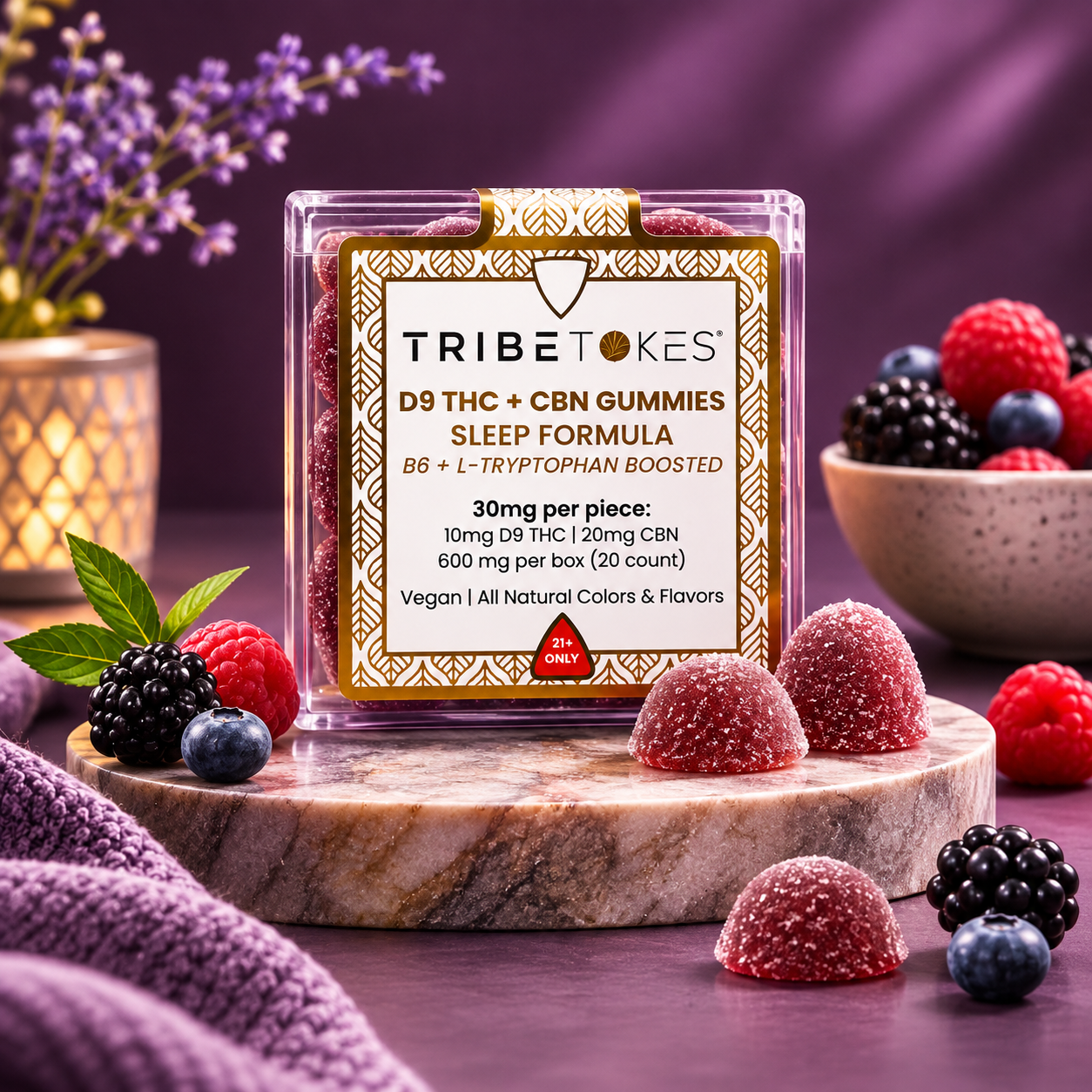
- THC Gummies for Sleep: 20 mg CBN + 10 mg Delta 9 THC, mixed berry. For people who also struggle to switch off at bedtime and are comfortable with THC.
- CBD + CBN Sleep Gummies: 20 mg CBN + 10 mg CBD, THC-free, peach. For people who want no high.
- CBN Gummies with Live Resin: 20 mg CBN + 10 mg CBD with terpene-rich live resin and trace THC, peach.
Product details:
- 20 gummies per jar, from $45; 4-piece sample packs for $10
- No melatonin in any formula; the THC and CBD formulas add L-tryptophan and vitamin B6, which the body uses to make its own melatonin
- Vegan (pectin, not gelatin), no artificial colors, sweetened with organic cane sugar and tapioca syrup
- Third-party lab tested, with a certificate of analysis for every batch
- 4.92 out of 5 from 394 reviews on the brand’s site at the time of writing
- Woman-owned, operating since 2017
TribeTokes suggests starting with half a gummy (10 mg CBN) 60 to 90 minutes before bed. That gives you room to step up to the full 20 mg if the first nights feel mild, which is a sensible way to use a compound whose effects are subtle. If you want a CBN product dosed to match the research, start with TribeTokes CBN sleep gummies and choose the formula that matches whether you want THC.
One caveat: the THC formula will show up on a drug test, and the live resin version contains trace THC. If testing is a concern, the CBD + CBN formula is the one to pick, though no cannabis product is guaranteed to pass.
2. Charlotte’s Web Stay Asleep (best CBN-only formula)
Charlotte’s Web Stay Asleep uses 20 mg of CBN isolate per two-gummy serving, with no CBD, THC or melatonin. The brand built it around the Bonn-Miller finding that CBD didn’t add to CBN’s effect. It’s huckleberry flavored, vegan, gluten-free and kosher, starting at $29.99 for 30 gummies. The catch is that a serving is two gummies, so a 30-count jar lasts about two weeks.
3. Slumber Deep Zzzs (best low-THC blend)
Slumber’s Deep Zzzs combine 8 mg of CBN with 25 mg of full-spectrum CBD and 3 mg of Delta 9 THC per gummy, with no melatonin. Most people won’t feel high from 3 mg of THC. The CBN dose is under half of the studied 20 mg, so this is more of a blended relaxation gummy than a CBN-forward one. Expect to pay about $2 per gummy at the one-time price.
4. Wyld CBD Elderberry (best budget THC-free option)
Wyld’s hemp line sells THC-free elderberry gummies with 25 mg of broad-spectrum CBD and 5 mg of CBN each. They’re made with real fruit and ship online. At 5 mg of CBN, you’d need four gummies to reach the trial dose, which also means 100 mg of CBD. Fine for a gentle wind-down, light for CBN’s main job.
Who CBN gummies suit, and who should skip them
CBN gummies make the most sense if:
- you fall asleep reasonably well but wake up during the night
- you want to avoid melatonin, or melatonin leaves you groggy
- you want a cannabinoid option without a strong high
Talk to a doctor first, or skip CBN, if:
- you snore heavily, stop breathing in your sleep, or wake up unrefreshed every day; these can be signs of sleep apnea, which needs a diagnosis, not a gummy
- you’ve had insomnia for months; cognitive behavioral therapy for insomnia (CBT-I) has far stronger evidence than any cannabinoid
- you take prescription medication, especially sedatives or blood thinners, since cannabinoids are processed by the same liver enzymes as many drugs
- you’re pregnant or breastfeeding
FAQ
How does CBN make you sleepy?
CBN weakly activates CB1 receptors, the same brain receptors THC uses, but at roughly a tenth of THC’s binding strength. That likely produces mild sedation without a high. In a 2024 trial, 20 mg of CBN a night reduced nighttime awakenings compared with placebo.
Does CBN actually work for sleep?
For ordinary poor sleep, the evidence is modestly positive. Two 2024 placebo-controlled trials found CBN improved sleep, one by reducing wake-ups at 20 mg and one by improving sleep quality at 25 to 100 mg. A 2026 sleep-lab study in people with diagnosed insomnia found a single dose didn’t reduce time awake during the night.
Will CBN gummies get me high?
Not at typical doses. Early human studies found oral CBN up to 400 mg didn’t produce THC-like effects. A CBN gummy that also contains THC will cause a THC effect.
Is CBN better than melatonin?
In one trial of about 1,000 adults, 50 mg of CBN worked about as well as 4 mg of melatonin. That trial was funded by a CBN supplier. CBN doesn’t add a hormone to your system, which is why some people prefer it.
How long before bed should I take a CBN gummy?
About 60 to 90 minutes. Edibles typically start working within 30 to 120 minutes, and a full stomach slows them down.
Can I take CBN every night?
The main trial ran for seven consecutive nights with no next-day fatigue. Long-term nightly use hasn’t been studied much, so check in with how you feel after a few weeks.
Is CBN the same as CBD?
No. CBN forms from THC and acts mainly through CB1 receptors. CBD comes from a different precursor and works largely through other pathways, with weaker direct evidence for sleep.