

















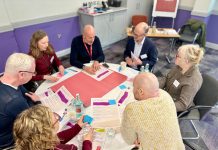



We spent the day at the Future Streets Forum, a one-day convening hosted by the Mayor of London, The Crown Estate and Bloomberg Philanthropies, and came away with a clearer sense of where thinking on city streets is heading. The room brought together city architects, mobility ministers, transport commissioners and retailers from Paris, Brussels, New York, Vienna, Sydney and Bogotá — with the future of Oxford Street and Regent Street as the immediate prompt, and a bigger question underneath it: how cities move from bold vision to real delivery. The Future Streets Forum showcased diverse ideas and perspectives and ones that Brighton should look at to help tackle its sustainability goals.
Below are the six ideas that came up most across the day, in the words of the people actually doing the work.
The Future Streets Forum demonstrated the collective ambition to create vibrant urban spaces.
1. Great streets are built for people, not cars
The importance of the Future Streets Forum lies in its collaborative vision for urban renewal.
The clearest message was the most fundamental. Cecilia Vaca Jones, Executive Director of Breathe Cities — a network operating across 14 cities from Bogotá to Nairobi to Johannesburg and Warsaw — described the street as a public space whose first duty is to be healthy, which means clean air in every street, not only the showpiece ones. Her challenge to the room was direct: if cities keep designing around traffic, when does the street ever actually change?
The insights from the Future Streets Forum will guide future urban planning efforts.
Bogotá was her proof point. Investment there has been concentrated in the city’s most vulnerable district — a deliberate choice to direct change where the health gains are greatest, rather than where the returns come easiest.
2. Green and blue space is a mental-health intervention
The Future Streets Forum highlights the need for inclusive design that prioritises community well-being.
Vaca Jones’s second theme was green and blue infrastructure — trees, planting and water — and not only for environmental reasons. There is strong evidence, she noted, that exposure to greenery and water improves mental health. A Transport for London speaker picked up the thread, pointing out that the Healthy Streets indicators already recognise how much green space, the chance to stop and socialise, and streets that aren’t too noisy or too fast matter to how people feel. Design those qualities in, the argument went, and wellbeing follows.
3. Begin with an idea bigger than the project
Bridget Smyth, Chief Architect of the City of Sydney, has spent two decades transforming George Street, a 2.5km spine that once carried 6,000 buses and cars a day and that people simply hurried through. Her first ingredient was the most quietly radical: hold an idea bigger than the scheme itself. Sydney wasn’t only redesigning a street — in 2006 it set out to reclaim the heart of the city for people rather than cars. The campaign drew sustained hostility, and the work still isn’t finished, but the team held the big idea tightly and kept going.


Through the Future Streets Forum, innovative approaches to urban mobility emerged.
Her second ingredient was less glamorous and just as vital: enabling infrastructure and operational foresight. Power, water, servicing and loading all have to be designed in from the start if a street is later to host events and adapt over time.
The focus on health at the Future Streets Forum represents a shift in urban planning priorities.
4. Get the edges right and the street activates itself
You don’t have to over-programme a street, Smyth argued, if you get the edges and activation right. In Sydney that meant studying the land uses along the corridor and engineering “fine grain” — small, varied tenancies that keep the street alive across day and night. The city used planning incentives, offering floor-space and height bonuses to developers who created fine-grain frontages and new public spaces. Tellingly, many retailers only opened up their buildings once the finished street showed them what it could do.
The Future Streets Forum serves as a model for future urban development initiatives.
Helen Marriage, Director of the public-art company Artichoke, made the complementary case for activation — how cultural programming and partnership bring genuine joy and delight to a street. Curation, the panel agreed, is what turns a route into a destination.
5. Data wins — and holds — the political argument
Engagement at the Future Streets Forum fosters a culture of innovation and responsiveness.
Will Norman, London’s Walking & Cycling Commissioner, was candid about how bruising street change can be, noting that he hadn’t expected to receive death threats over cycle lanes. His point: data is how you build and sustain political will — both the quantitative numbers on air quality, cycling and health, and the qualitative, lived-experience stories that turn a local pilot into a city-wide policy and give campaigners the evidence to demand more.
Lilli Matson of Transport for London put figures to it. Describing a neighbourhood touched by clean-air measures, she said residents could name nothing they had stopped doing — yet the air was roughly 40% cleaner. People fear what they might lose, she suggested, and struggle to see what they gain; visible air-quality monitors help make that hidden threat real. Vaca Jones added that reliable monitoring is often what unlocks political action: of the 14 cities Breathe Cities works with, 10 are already developing their own versions of low-emission zones inspired by London’s ULEZ.
6. Think like the customer planning their visit
The sharpest challenge came from Sean Ghouse, Director of Retail UK at Fortnum & Mason, speaking for the high street. With so much energy poured into making cities great, he asked, where does an actual visitor go to plan it all — Instagram, Facebook, a website? Which single place curates everything worth doing, simply enough to build a trip around? Great streets, his point implied, need great storytelling to match.
What we took away from the Future Streets Forum
The lessons learned from the Future Streets Forum will influence future urban policy decisions.
For all the focus on Oxford Street and Regent Street, the Future Streets Forum was really about a transferable method: start with people and their health, treat green space and flexible infrastructure as essentials, get the edges and activation right, measure everything, and tell the story well. As Bridget Smyth reflected on twenty years in Sydney, sometimes people only believe in a street once they can see it finished. The quiet ambition in the room was to help more cities reach that point — and to keep going when it gets hard.
Ultimately, the Future Streets Forum aims to inspire action that transcends individual projects.
Further reading: Transport for London’s Healthy Streets approach.

See also: →Things to Do in Brighton| Events Brighton | Arts & Culture Brighton | Food & Drink in Brighton |Wellness in Brighton| Places to Visit Near Brighton | The Best Hotels | Brighton Journal Stays | Contact|