

















Disclosure: We attended Henry Moore After Hours as guests of Kew Gardens on a press ticket. All views are our own.
There are evenings that remind you why a garden can be the best room in the city. Henry Moore After Hours, the summer late-opening that wraps around Kew’s Henry Moore exhibition, was exactly that: an unhurried, golden-hour wander between bronze and birdsong, with music, dance, clay and a sky doing its very best impression of a Turner painting. After a scorching day, it was precisely the kind of slow, sensory evening worth seeking out.
As we strolled through the captivating environment of Henry Moore After Hours, we were enchanted by the evening’s beauty.
Plants that sing: Plants Can Dance
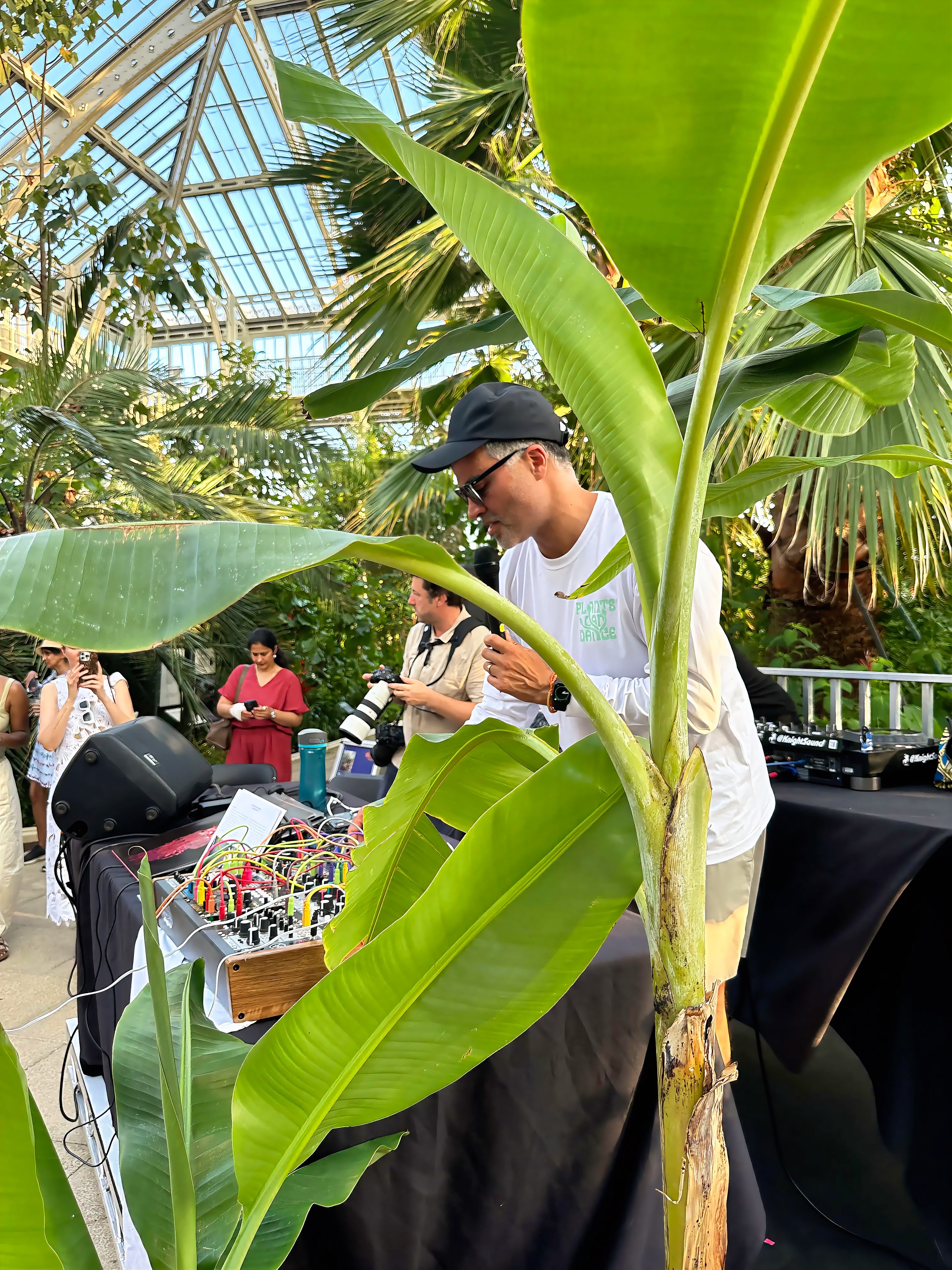
The night’s quiet headline was Plants Can Dance, a performance and DJ set by sound artist Brian d’Souza, who records and performs as Auntie Flo. Inside the Temperate House — the world’s largest Victorian glasshouse, all soaring iron and palm fronds — d’Souza turned living plants into instruments through a process called biosonification.
The experience of Henry Moore After Hours was further enriched by the intertwining of nature and art.
If, like one visitor that evening, you find yourself asking “but what’s the science behind it?”, here’s the short version. Two small electrodes are attached to a plant, and the device measures the tiny, constant shifts in electrical conductivity between them. Those fluctuations depend largely on water moving through the plant and the ions dissolved in its sap — so a well-hydrated plant produces a richer, livelier signal. That stream of data is translated into MIDI and fed to a synthesizer, which renders it as sound. You’re not strictly hearing the plant, then; you’re hearing its electrical life mapped into music.
What stayed with us, though, was how much the piece made you wonder. You reach out and touch a leaf, and the sound shifts — because suddenly you’re part of the circuit too. Then the questions start, the open, slightly childlike kind you stop asking as a grown-up: does each plant sing differently? Is this a happy sound, or a sad one? And — as one of us asked aloud — could a stone join in too, since surely it holds some quiet energy of its own? The installation never lectures; it simply hands you that curiosity and lets you stand inside it. (Later, by the DJ set, a few plants had wilted in the day’s heat and their voices thinned — a small, oddly moving reminder that this music is alive.)
Dancing among the sculptures
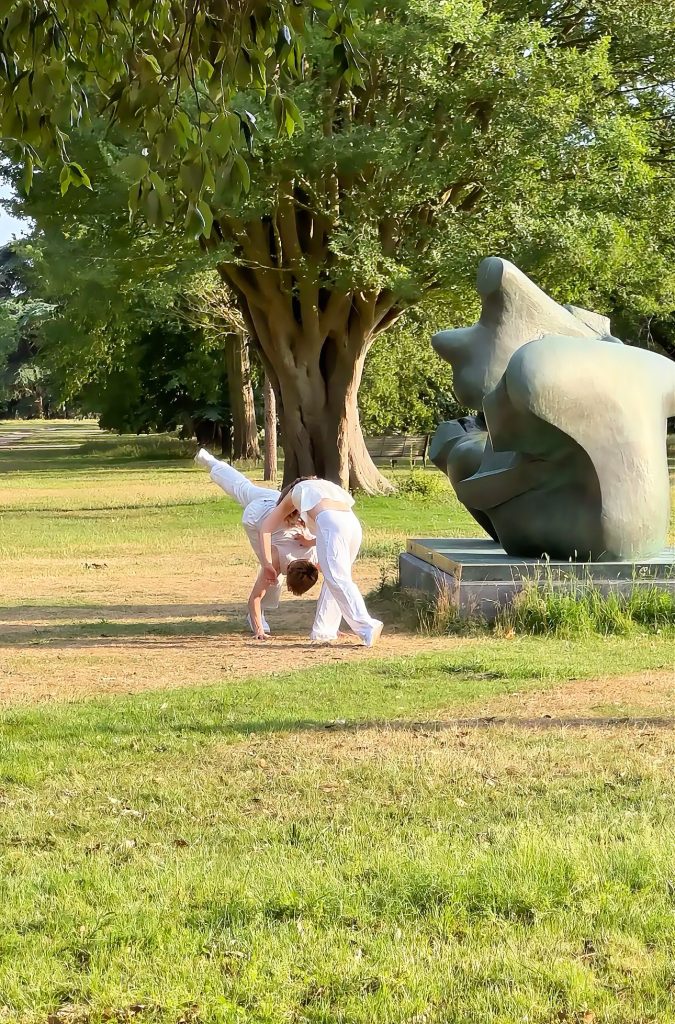
Out on the lawns, dancers from Rambert School moved among Moore’s reclining bronzes, dressed in white against the green. It was a genuinely lovely piece of programming: the dancers’ curves and pauses echoing the sculptures’ own organic forms, so that for a moment it was hard to say which was the still life and which the living one. Moore always insisted his work came from nature — bones, pebbles, the human body at rest — and here it felt completely at home.
This harmonious atmosphere is what Henry Moore After Hours aims to cultivate each summer.


Shaping the coast in clay
Under a marquee, ceramic artist Zivarna Murphy ran a drop-in sculpture-making workshop. A research-based conceptual artist, Murphy explores coastal erosion as a metaphor for human loss, layering clay with textures drawn from shells, rocks and fossils collected along the East Yorkshire coast. Visitors were invited to shape their own clay miniature, inspired by Moore, the Kew landscape and those same natural forms, and take it home at the end of the night — the kind of hands-on, no-pressure making that quietly turns a spectator into a participant.
Visitors could feel the inspiration drawn from Henry Moore After Hours as they created their own pieces.
Sketching the sculptures
Nearby, artist Sylwia Narbutt led a drop-in drawing workshop, part of a programme co-curated with the Working Class Creatives Database — and we couldn’t resist a go. Narbutt’s own practice uses drawing as a way into wild, hidden and overlooked things, and that spirit proved contagious: clipboard and coloured pencils in hand, we found a patch of grass as the festoon lights came on and had a proper attempt at one of Moore’s great reclining figures, the form softening as the light went. There’s something quietly joyful about a whole field of people, all ages, sketching sculpture at dusk — and you take your drawing home at the end. Ours, all loose colour and wonky confidence, is staying on the fridge.
Drawing under the stars at Henry Moore After Hours felt uniquely rewarding and creatively freeing.
Food, wine and a Turner sky
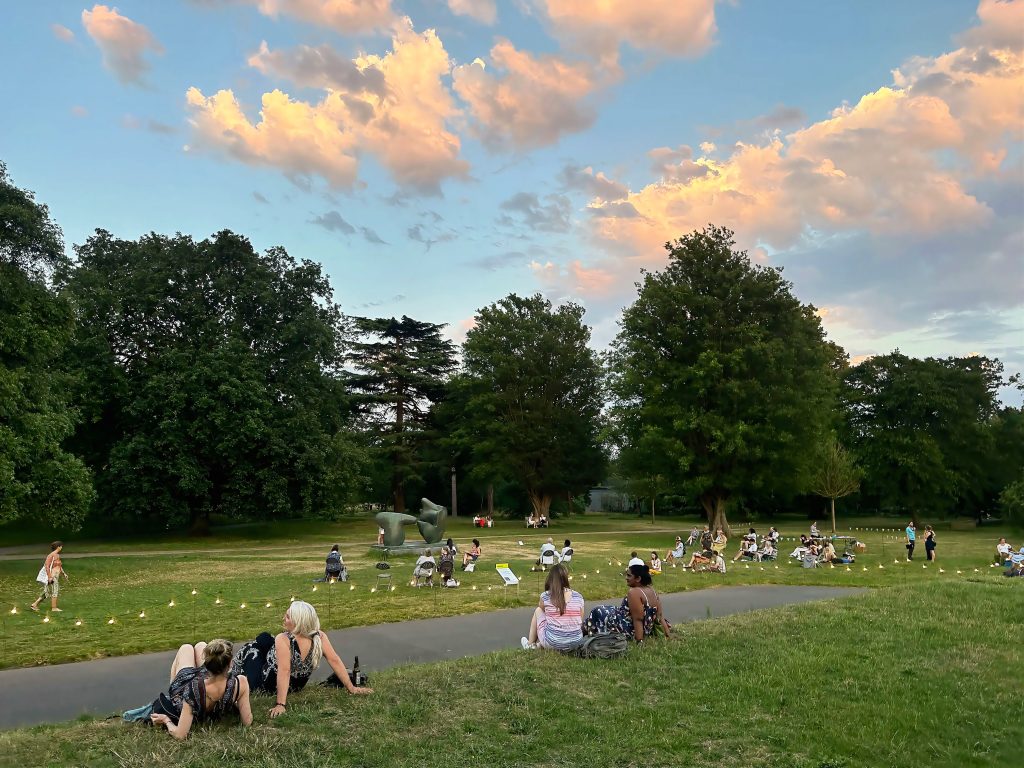
The rest of the evening simply invited you to linger. The Food Village kept things easy — cocktails, pizza, burgers, shawarma and more under stretch tents — while a bar poured chilled wine and fizz from ice buckets onto the grass. As the light softened, festoon lights flickered on along the paths and the sky over the Temperate House turned that improbable pink-gold that has launched a thousand cloud studies, from Constable to Turner. People sat out on the lawns with a drink, in no rush to be anywhere.
These moments are what make Henry Moore After Hours unforgettable.
Every detail contributed to the enchanting vibe of Henry Moore After Hours.
Henry Moore After Hours: the verdict
Henry Moore After Hours got the balance exactly right — culture you can engage with as lightly or as deeply as you like, threaded through one of the most beautiful landscapes in the country. Co-curated with the Working Class Creatives Database and themed around the summer solstice and Moore’s lifelong love of nature and mythology, the evening had a single through-line: plants turned into music, clay and pencil shaping new forms, dancers tracing the curves of Moore’s bronzes, all beneath a painterly summer sky. It was, in a word, magical — and after a hot day, an unhurried evening like this is exactly the tonic a city needs.
Henry Moore After Hours presented a delightful blend of culture and nature.
After Hours returns on 27 June and 3–4 July 2026 (note it’s strictly for over-18s), while the wider exhibition, Henry Moore: Monumental Nature — 30 sculptures set across the Gardens — runs until 31 January 2027. tikets https://www.kew.org/kew-gardens/whats-on/henry-moore-after-hours
Mark your calendars for the next Henry Moore After Hours events.
If you can’t make it to Kew, the good news for those closer to Brighton is that a parallel Henry Moore presentation, Henry Moore at Wakehurst, is on show at Kew’s wild botanic garden in West Sussex — far closer to home, and well worth the trip.
For those who missed out, Henry Moore After Hours will return with even more surprises.
See also: →Things to Do in Brighton| Events Brighton | Arts & Culture Brighton | Food & Drink in Brighton |Wellness in Brighton| Places to Visit Near Brighton | The Best Hotels | Brighton Journal Stays | Contact|
Henry Moore After Hours invites everyone to experience the blend of art and nature.