






















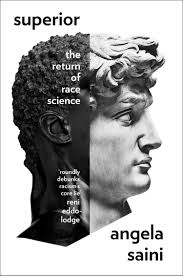
This week, I spoke to the brilliant Angela Saini, author of the multi-award winning Superior, a rigorous and powerful study of the resurgence of race science in the 21st century.
Angela was due to speak at this year’s Brighton Festival, which has unfortunately been cancelled due to the coronavirus crisis.
Among modern scientists, the general consensus is that the “race” catergories so deeply ingrained in our minds have no basis in biology. They are instead the product of politics; specifically, of European powers seeking justify their colonial projects by framing their power as natural.
These European powers devised the racial hierachies that still play out in society today, and used “science” to solidify them, positing that we are not all the same beneath our superficial differences, and that white people are innately superior.
Nowadays, however, we like to believe that we have moved beyond scientific racism, that most people accept race as a social construct, not a biological one. But in recent years, race science has been experiencing a revival, fuelled by the misuse of science and the manipulation of data by certain political groups…
Reading Superior, one thing I’m struck by is the absolutely relentless doggedness of the so-called “race realist” scientists you talk about, and even scientists with supposedly “benevolent intentions” like those involved with the Human Genome Diversity project, on their quest to prove that there is some kind of biological basis to race. Despite endless setbacks and evidence proving their theories wrong, they just will not admit defeat. In your opinion, why, despite all the evidence being against them, are these people still going?
I think there are two dynamics at work. One is the persistence of racial stereotypes in wider society, which affect how we all think about human difference from a very young age, and mean that even well-intentioned scientists of different backgrounds keep resorting to race even when its biologically inappropriate. The other dynamic is out and out racism, which is what we see at play among so-called “race realists”, who are politically committed to the idea that there are deep-seated racial differences that can explain global and social inequality. Race realism, of course, is a euphemism for what is clearly just racism. They use these kinds of phrases to appear to separate themselves from the racists of the past, but they are the same. Their ideologies are identical to the intellectual racists of the nineteenth century who were committed to colonialism and segregation. So the difference here is intent – we are all affected by racialised thinking, it is structurally ingrained. But those on the far-right, the racists, are motivated by hatred and politics.
Following on from this – how the hell are these people still getting funding, sometimes even from well respected universities? To what extent do you consider the motivations of the people funding them to be economic – driven by a desire to find some kind of biological justification for inequality to help ensure they remain the wealthy ones?
The belief in deep racial differences has been around for a very long time, and it actually underpinned much of the politics of the last few hundred years, including colonialism, slavery, genocide, segregation, apartheid, and it still affects how we live and treat each other. The fact that more black Americans are contracting Covid-19 is a product of this structural inequality that has a chokehold on us even now. There remain powerful people out there, including politicians and academics, who nurture the belief that the racial inequalities we see out there are not historical or political in origin, but just because we are fundamentally different, that these differences can even explain the course of history and European achievement. They want to be able to make these arguments because then they don’t have to change anything or admit that society is unfair. I believe this is one reason why intellectual racism persists. In Superior, I’ve tried to document some of the patterns of support and funding for these ideas, including the story of Mankind Quarterly, a journal set up by a handful of scientific racists after the Second World War, lavishly funded for decades by a wealthy American segregationist to propagate the kind of ‘research’ deemed of too poor quality to be published anywhere else. Remarkably, Mankind Quarterly is still in publication today.
In the book, you mention a study conducted by the geneticist Richard Lewontin which found that “there was far more (genetic) variation among people of the same “race” than between the supposed races, concluding that around 85% of all the genetic diversity we see sits within local populations”. Could you just say a bit more about exactly what this means?


Essentially, we have known for many decades that the vast majority of genetic difference is between individuals, not groups. And even the differences there are between groups are fuzzy and statistical. There are no black genes, no white genes, in fact no gene that exists in all the members of one “race” and not another. When scientists talk about race being a social construct, this is what they mean. You can divide humans up any way you like, but the ways we happen to have chosen are motivated by politics, not biology.
Similarly, you talk about how “there are no hard genetic boundaries around human groups, but rather continuous variation”, and that this variation is largely “trivial”. Does this mean that, theoretically, I could have more in common genetically with someone living on the other side of the world than someone considered to be of the same “race” as me, living at the end of my street?
Yes, it is statistically possible for that to be true. So, nobody is saying that there is no human variation. Of course there is, but it doesn’t work the way we imagine. It isn’t defined in a hard and fast way by biology. If there is one thing we know it is that every individual is different and what makes a person special, what gives them their particular qualities, is those individual differences. They overwhelm everything else. We are more genetically homogeneous as a species than all other primates, even chimpanzees. But of course, this isn’t the point. The point is how much effort we have invested into trying to prove that race, once constructed, matters. It does not matter biologically, only politically. But the politics is everything.
Many of the race scientists you write about are obsessed with finding “intelligence genes”, evidence to prove essentially that white “races” are more intelligent than other races. To me, this sounds like an absurd direction of study from the outset, because how on earth are you even supposed to pin down what intelligence is? Surely a judgement on someone’s intelligence is to a large extent subjective anyway, so isn’t the whole basis of their study ridiculous, before you even get into that fact that time and time again studies of this sort have completely failed to produce the discoveries they were after? What do you think?
Again, this comes down to the point of race. If the point is political, to justify social inequality, then you would absolutely expect racists to insist that there are innate intellectual differences between population groups, just as sexists insist that men and women aren’t equally smart as each other. The argument, whether or not it has any basis, serves a political purpose. Yes, scientists don’t fully understand intelligence or what it is, but for the racists, they don’t care. They never did. Indeed, a lot of the first research into intelligence was born out of scientific racism and eugenics. Intelligence research as a field is still plagued by racism in some corners to this day.
One of my favourite quotes from the book relates to the reason nationalism can be appealing to people: “The power of nationalism is that it calls to the part of us that doesn’t want to accept being ordinary.” There is, without doubt, a part inside all of us that wants to feel a sense of belonging, that ‘“we” are somehow innately special. (As you say, this is nothing new, and cultures have always relied on origin stories to deepen their sense of connection to their land. Some have used this notion of being “special” to justify brutalizing other people and their land.) Unfortunately, recently it has been far-right nationalists and nativists who have stepped in with stories to fill this part of us. To what extent would you put the rise of far-right nationalism and nativism down partly to a failure of the progressives amongst us to provide an equally appealing, but kinder, more inclusive story of why we are special, one which reaches out rather than builds up barriers, and attempts to include all people, from all walks of life, within this “we”?
I think we had this story for a while, a universalist narrative that reminded us that we are one human species, united in common values and principles, such as human rights. For some reason, this has become quite unfashionable these days, but I do think that alongside fighting for our rights as women, as minorities, as disabled people, whatever identity we have, we also need to remember that we are all human and all the same underneath. I am not here to fight other groups of people. I’m here to fight damaging, dangerous and nonsensical ideologies that seek to divide us.
Thanks Angela! Superior is out now, published by 4th estate.
Featured image: Angela Saini (left) and Samira Ahmed (right) at the Rosalind Franklin lecture, via Wikimedia Commons