


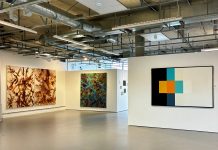





This week Brighton Journal spoke to local visual artist and designer, Anastasios Veloudis. After completing his Masters degree in Digital Media at the University of Brighton in 2013, Anastasios has taken part in many exhibitions across the globe. His work was selected for the 15th Biennale of Young Artists in Greece, and is represented in the collection of the Macedonia Museum of Contemporary Art. He now lives in Brighton, creating dynamic abstract work that frequently explores the contrast between geometric and organic forms. We discussed Anastasios’ inspirations, as well as his favourite things to do locally. Take a look.
What are you doing today?
Today is just another day of working in my studio. The only difference is that for the first time the outside world is much quieter than inside. Good music, some sun and a nice dinner can make up for the uneasy times we are all going through now.
Describe where you do most of your creative work.
Working in my studio is my everyday routine. That’s why having some creative time during an art residency is important for my work. It gives me the chance to break the monotony of everyday tasks, meet new people, travel and expand my creativity by challenging my art practice.

What’s the most exciting thing you’ve worked on?
During my last residency in Estonia I had some great times, as it gave me the time and support to expand my vision through practising in much bigger scale and with a variety of tools that I have not worked with before. Also, the design work that I have done recently for the Hong Kong Museum – in collaboration with a design agency in London – offered me a valuable experience and a great time working alongside a talented team of various creatives.


What made you decide to become an artist?
I tend to believe that there is an invisible force that decides for us what we should do in life. I was always gravitating towards art without ever questioning the deeper meaning. Maybe there isn’t any, perhaps it is all about taking the risk to enjoy the freedom of being with yourself, and wondering what you should do next.

What are you currently working on?
At the moment I am working on a new series of sculptures based on discarded materials and spontaneous action paintings. There is never a final destination I am looking to reach, but mostly a perpetual effort to take advantage of any irrational outcome arising during my practice. It is like trying to take the chaos of my mind and translate it into a visual narrative.
What are the key themes in your work?
My practice has been constantly drawn towards abstraction and non-literal, metaphoric forms – working with a variety of tools, from acrylic paint and paper collage to photography and video. Duality is ever-present in my work; combining dynamic geometrical shapes with organic free flowing forms. Practising abstraction is a denial of formal materialism and the representation of the rational observation of the world. A visual outcome of my understanding of the world.

What would you like people to notice about your work?
Like in Schrodinger’s Cat experiment, where cat is both alive and dead, the art suggests an open, endless interpretation. A moment where all narrations are probable and there is nothing to be understood by the mind. A moment where you can allow any connection to happen, without anything or anyone forcing it, for any reason. A moment of freedom. If people could notice that sense of freedom, then I will have probably succeeded.
What attracts you to the medium you work in?
Automatism plays a vital role in my art practice: using a variety of materials available gives me the freedom to follow an intuitive action. Spontaneous painting or drawing, along with an irrational assembly of materials and objects in experimental association, reveals its purpose after a peaceful meditative process.

What equipment could you not do without?
As for most people nowadays, my computer is a tool of inspiration, research and creation. It is something that I would choose to always have with me, although that doesn’t mean that I could not keep up with my practice without it.
Who or what inspires you?
The outcome of my practice occurs as a by-product of my ongoing efforts to explore and understand new radical approaches on mind, body and spirit. These concepts – informed by studies on a philosophical, spiritual, and scientific realm – have always been a vehicle for my personal transformation and, as a result, the source of my inspiration.

How is your work affected by living in this area?
Living near the sea opens up the mind. It offers me quietness, and at the same time an easy access to the vibrant art scene of London where I go very often for an art tour day.
What’s your favourite thing to do locally?
Spending time on the seafront is always the best way to refresh my mind. A walking meditation gives me the energy and motivation to keep up with my schedule.

What’s your favourite gallery (or place to see/experience art)?
The first gallery I visited when I came to London as a tourist many years ago was Tate Modern. Since then, it’s always been the place I could spend endless hours enjoying the variety of content.
If you could collaborate with one artist, from any time, who would it be and why?
The list could be endless, as I really admire a lot of artists from different periods across the history of art. At the moment, as I am reading a book by Philip Larratt-Smith and Rudi Fuchs about the life and work of Jannis Kounellis, I am really inspired by his ground-breaking sculptures made from charcoal, wood and iron.

What’s your favourite colour?
Turquoise is a very significant colour for me. It combines the tranquillity of a blue sky along with the vibrant green down on earth.
To find out more about Anastasios and his work, check out his website.