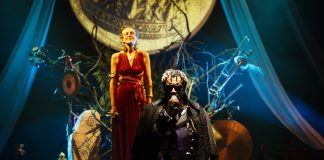


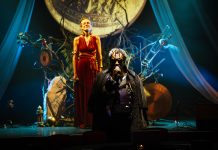
















In a cosy Hanover pub, playwright Tim Crouch leans in, disarming and dryly funny as he unpacks the magic behind An Oak Tree, his ground-breaking play comes to Brighton Dome after twenty years of touring the world.
This weekend, some of Britain’s most celebrated actors, Fisayo Akinade, Ruth Wilson and Rory Kinnear, from James Bond and Black Mirror fame, will take turns joining Crouch on stage for its 416th, 417th and 418th performance. The twist? Each night, a new guest steps into the spotlight with no rehearsal, no prior script, and only an hour with Crouch to prepare before facing a live audience.
What follows is part high-wire act, part hypnotic experiment, a tightrope walk along what Crouch calls “the very fabric of theatre”, where instinct and imagination replace certainty.
“Theatre is full of pale imitations of telly on the stage. An Oak Tree is not a pale imitation of telly on the stage.”
Now correct me if I’m wrong, but I read that this play was born out of your frustrations with the industry. How has this play, now twenty years after writing it, shaped your relationship with the industry?
“So in the last twenty-two years I have just made my own work because I just got bored of complaining about other people’s work. I was an unhappy actor and I’m a much happier writer.
My work is addressing not just issues in theatre but issues in the world. And I always think my work will change everything, will change the world, but it’s not like that,” he laughs,
“it’s not as simple as that. Lockdown brought some changes; everyone got really scared, they thought the audience would disappear so they just started putting really famous movie stars in shows. I understand that sounds hypocritical on my part because I have famous movie stars in my shows. An Oak Tree is not just about famous people, because the moment the show starts, within five minutes you forget it’s Ruth Wilson or whoever.”
“The fact that there is an actor in the middle of this play that doesn’t know the play speaks profoundly to our situation in the real world, and also to our daily situation, being in the world and not knowing what’s coming next.”
How do you disarm an audience at the start of a play?
“I’m really honest. And then I tell them the story. Once the story begins, everything changes. In this play I play a hypnotist, and I’m not a hypnotist, although I think all art is a form of hypnosis, a gentle disorientation and then the suggestion that something is or isn’t and theatre happens on that level all the time. If it didn’t happen on that level all the time you wouldn’t believe the actor.”
“It’s also very playful, because I think it’s kind of like how children play. A child says to another child, listen, let’s play this. I’ll be this, and you be that. And I say that, now you say that… it’s got that same kind of simple, ‘let’s pretend’ kind of qualities.”
The technicalities


Tim explains that before they agree to do the show, the actors get a document saying are you okay to sight read, okay to wear an earpiece, the implication is to release, please don’t read the play, it’s better for you and everyone to come into it fresh.
And then Tim says the story of this play concerns the death of a child, and if that story is close to you in any personal way, we advise against you doing it.
“I don’t think theatre is this psychological journey for the actor. I’m not allowing my actor to rehearse for six weeks, to go all Stanislavski to find their emotional trauma, to draw on their emotional trauma, their character, because they’ve never seen any of the lines before. And I think that makes for a better performance. I don’t think theatre is necessarily that psychological, Freudian investigation that a lot of people think it is.”
“The fact that there is an actor in the middle of this play that doesn’t know the play speaks profoundly to our situation in the real world, and also to our daily situation, being in the world and not knowing what’s coming next.”
You’re putting your play in the hands of somebody that you might not have even met before, or you’re not very familiar with. It requires a certain amount of trust. Have you ever felt that trust be pushed to the limit?
“The danger is the idea of that fear…
“I understand the nerves exist, I do everything I can to help them through it. So no, nobody has destroyed the play, and even if the play was destroyed, I have an image in my head of, in the middle of a performance, an actor going ‘I can’t do this’ and leaving. I would be very generous to that decision, and then I would turn to the audience and go, ‘We need someone on stage to finish the play.’ In the same way, if the actor didn’t turn up, if there was a train strike and the actor booked for the night doesn’t arrive, I would walk on stage and ask, ‘Hi everyone, we need someone who can sight read, wear an earpiece for part of it, and if you’re happy to do that, come and do the play with me.’
That’s never happened. The nearest that came to happening, Mike Myers did the play in New York and he was late, he arrived about ten minutes before the show started and I was preparing myself for the plan B, asking the audience. Then he did arrive, and we hardly had time to talk, and then the show was great. The show doesn’t need that time, but it does need an actor.”
“You can’t fuck the show up, the show is unfuckupable. Not everyone will love it, but no one has tried to sabotage it. No one has tried to sabotage it because anyone who does the show will have my undying support until the end of time because they put themselves in that place with me.”
Would you ever do a special performance where you take the show to the public and invite anyone up on stage with you, or perhaps a drama school?
“Now that’s really interesting, a drama school, they’d be thinking about performance. But would I take it to the general public? No. Because I might pick someone who has difficulty sight reading or dyslexia, and then the play would become about watching someone struggle, and that’s not what the play is about. There’s a big emotional part of the story, and I might pick someone who has a particular relationship with the emotions of that story, and then we watch someone suffer through that.”
“There once was an actor who cried his way through the story, and it was amazing, but now the audience just remember a man crying the whole time, which is not not the play, but it’s not the play.”
Twenty something years ago you wrote the play, how has the grief you’ve experienced in that time affected how you perform yourself?
“In this play I have to be on it. And there are some performances where I get deeply moved, and that actor, if they’re working in a level of security and comfort, allows me to go with it. But most of the time, predominantly, my focus is on the other actor to help them.”
“I wrote the play when I had a twelve-year-old daughter. There’s a twelve-year-old girl in the play. She ain’t twelve anymore… Gosh, she’s 36 now, is that right? 36…”
And I could see Tim go from being the puppeteer, the grandmaster and playwright extraordinaire that I was interviewing, to just being a dad with a grown-up daughter wondering where all the time had gone. I saw him quickly snap back into it and continue to answer my question, and the themes of this play and our conversation played out infront of me, where, like himself or any other actor he invites onstage, must remove their emotion to deliver their line for the audience, in this case, me.
“Anyway! I had a daughter who played the piano, and in the play the girl plays the piano, and it’s about imagining a loss. And now my daughter has a son, and so that imagination has changed a lot.”
Is there an actor, dead or alive or no longer performing, that you would love to perform with you, that would bring something totally new?
“Well, I kind of had that in Edinburgh with David Threlfall, you know, the actor from Shameless, exceptional, free actor, my god he’s so free. He paid for his train, paid for his Travelodge, he came all the way to Edinburgh, he just wanted to do the show.”
“It’s about confidence and freedom, it’s written to be different every time. But the play is kind of written to fail every time, to fail because I’ve never heard the lines said in the way I imagined them being said when I wrote them. Because these actors are reading them for the first time. So that’s why I say it’s unfuckupable, because if it fucks up that’s kind of part of the play.”
An Oak Tree is based on the conceptual art piece This is an Oak Tree, which is actually just a glass of water. So now if you were to tell me an oak tree is a person, and that person lives in Brighton, what sort of person would they be?
“So you’re talking to a resident of Hanover of 27 years, and in the Village, which is a space for community that has live music, that has an aesthetic that is kind of ad hoc and free. I once performed another play of mine in Laurence Olivier’s house on Royal Crescent, but I don’t think An Oak Tree is a Regency play. I don’t think it’s a Revenge Nightclub play or a Brighton Centre play, but there’s a grandness of ambition because it’s just me and them.
I’d like to have performed it at Nick Cave’s house… can I just say Nick Cave is the man in terms of how he writes about loss, and everything he has created in response to his loss is chef’s kiss.
An Oak Tree is absolutely a Nick Cave play. Yeah, in response to your question, if this play was a person, who would it be? It would be him, and I think he’s a genius in terms of finding an artist’s response to loss, he, more than anyone I know, is right in the middle of that.”
Talking to Tim was unexpectedly grounding. It’s easy, from the outside, to see theatre as he says, as this deep Freudian exercise. But the way he invites his actors to step into the unknown, like children at play, is quietly disarming; a gentle reminder of the instinct and imagination that first made us fall in love with stories… a beautiful return to something honest and instinctive that we forgot somewhere along the way.
To watch An Oak Tree this weekend, head to Brighton Dome’s website and grab the few remaining tickets here