


















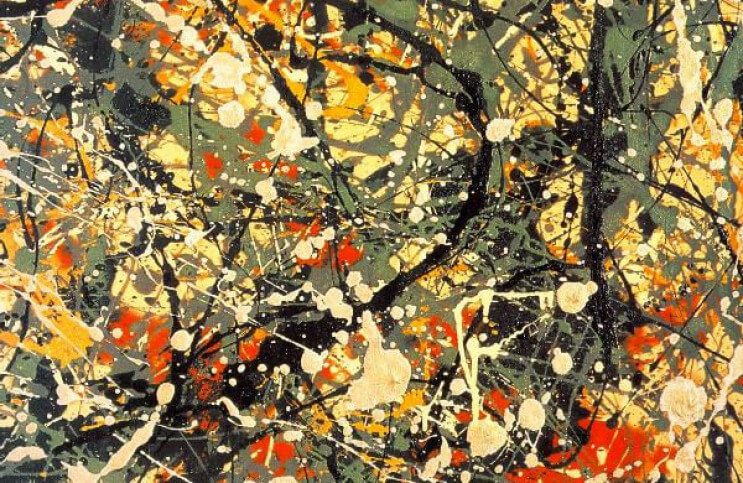


Among so many styles and eves, we find Abstract Expressionism. It is widely recognized as one of the most revolutionary art movements which has ever existed. Emerging towards the mid-twentieth century, it was behind artworks filled with energy during the early 1940s. In 1948 Barnett Newman – one of the major figures in abstract expressionism – said:
“We can no longer paint men playing the cello or bouquets of flowers: the subject is the prime element of painting; the history of my generation begins with the problem of what to paint”
The opposition between “the what” and “the how” turned the Abstract Expressionist’s circle upside down. For the first time in its history, America was setting trends, and New York had incontestably become a “inspirational city”, a lively centre of research and debate. Suddenly there was an urgent feeling to overcome the provincialism of American Realism Art and forget the 1929 economic crisis began with the early thirties.
These new artworks were innovative, fresh and exciting, full of life as nothing seen before. The main feature of this new way of interpreting art was behind the creation: free, wide gestural brushstrokes. The paint was poured or dripped directly onto the canvas – a new technique lately called “Action Painting” (if you’d like to know more about this, we suggest you to read also this article on Kooness Magazine about action painting examples).
Jackson Pollock, Willem de Kooning, Lee Kasner and Gerhard Ritcher are some of the main artists behind these ground-breaking works. Their masterpieces were instinctive and dynamic, like many other artworks created by different artists during this period, up until the 80s. Abstract Expressionism encompassed painting, incorporating performative rituals and spiritual elements. It was strongly connected to North America, where European artists had brought the teachings of artists like Matisse, Miró and Picasso, their strokes, automatic techniques, and progressive compositions.
Indeed, rising from the innovations and techniques brought to the Arts in the late 19th century, Abstract Expressionist artists could reach to an extensive toolkit. Action painting is famously and so often associated with the work of American artist Jackson Pollock. According to Pollock, only the result matters and “.. it matters little how the colour is applied once something has been said”. Action became then core to painting – as a performative ritual and spiritual act. It was a new, holistic approach of painting and understanding paintings. The act of painting, and paint as a medium, became central. Jackson Pollock said.
“Today painters do not have to go to a subject matter outside of themselves. Most modern painters work from a different source. They work from within..”
When we look at an Abstract Expressionist artwork, we see the artist poring or throwing with energetic movements, leaving marks on the canvas with vigorous, animated gestures. Action is a means of expression and, to understand an Abstract Expressionist work, we must understand the action. We encounter the artist and the drive behind these works by looking directly at the paintings, familiarizing with the physical nature of the movements and materiality which prevails them. Far from figurative, they still maintain that connection with the body, energy and emotions which permeate our reality.