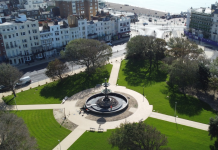





















Few buildings in Britain surprise visitors quite like the Royal Pavilion Brighton.
With its domes, minarets and exotic silhouette rising above the Brighton skyline, the palace looks more like something transported from India or the Middle East than a royal residence on the English seaside.
Yet step inside and the Pavilion reveals something even more fascinating — a spectacular blend of Chinese, Egyptian and classical European influences, created during a period when Europe was captivated by distant cultures and artistic imagination.

The Vision of George IV
The Royal Pavilion Brighton was created for George IV, a monarch famous for his extravagant taste and passion for art, architecture and entertainment.
Born in 1762, the young prince first visited Brighton at the age of 21. At the time the seaside town was rapidly becoming a fashionable destination for Britain’s high society.
Brighton offered something London could not: freedom.
The town soon developed into a lively playground of theatres, racecourses, gambling houses and elegant libraries — a social scene that perfectly suited the prince’s personality.
Here he began building a residence that was not simply intended as a palace, but as a place designed for spectacle, hospitality and pleasure.


Architecture That Plays With the Senses
Walking through the Royal Pavilion Brighton can feel almost theatrical.
Visitors pass through rooms filled with colour, glittering chandeliers and dramatic drapery before suddenly entering calmer spaces designed for conversation, card games and private gatherings.
This contrast between spectacle and intimacy was entirely intentional.
The famous Banqueting Room dazzles with its extraordinary scale and elaborate decoration, while nearby rooms provide quieter settings where guests could relax away from the grand public spaces.
Much of the Pavilion’s transformation was overseen by architect John Nash, who expanded the residence with new wings, grand kitchens and lavish reception rooms.
A Ceiling That Tricks the Eye
One of the Pavilion’s most remarkable features is its use of visual illusion.
In one room visitors are encouraged to look up at what appears to be a domed ceiling opening onto the sky. Painted clouds drift above, framed by decorative foliage.
But the illusion is deceptive.
The ceiling is not actually a dome — it is shaped like a tent. Some of the leaves are painted flat onto the surface, while others are sculpted in three dimensions and project outward into the room.
These sculpted elements cast real shadows, creating the impression of depth and movement. The mixture of painting and sculpture subtly tricks the eye, a technique repeated throughout the Pavilion’s interiors.
Europe’s Fascination With the East
Much of the Pavilion’s decoration reflects Europe’s fascination with Asia during the late eighteenth and early nineteenth centuries.
Many of the Chinese decorative objects displayed in the palace were produced specifically for export to Europe. Porcelain pieces created in China were later transformed in Britain into elaborate decorative objects.
Some porcelain columns, for example, were mounted in dazzling gilt bronze and converted into enormous candelabra by decorative artist Robert Jones.
At the time porcelain was one of the most mysterious and coveted materials in Europe. For decades European craftsmen attempted to uncover the secret of its production.
The breakthrough eventually came in Germany when Johann Friedrich Böttger developed the formula for European porcelain at the Meissen manufactory near Dresden in the early eighteenth century.
Before that moment Chinese porcelain was treated almost like a precious jewel. In the Pavilion it was often set within elaborate gilded mounts to emphasise its rarity and beauty.
A European Dream of China
European understanding of China during this period was often imaginative rather than accurate.
Decorative figures imported from China were frequently misunderstood by European collectors. Many were produced using moulds, meaning several statues shared identical faces while hairstyles and clothing were added later by hand.
For a long time even museum curators struggled to determine whether certain figures represented men or women.
Chinese wallpapers used inside the Pavilion reflect this confusion. Although clearly produced in China, they were historically referred to as “India paper” because they were imported to Britain through the East India Company.
Egyptomania and the Age of Discovery
The Pavilion’s eclectic decoration also reflects another cultural fascination of the period — ancient Egypt.
After French scholar Jean-François Champollion deciphered Egyptian hieroglyphs, Europe experienced a wave of interest in Egyptian art and symbolism known as Egyptomania.
Elements of Egyptian, Chinese and classical styles appear side by side throughout the Pavilion, creating interiors that celebrate imagination rather than strict historical accuracy.
From Royal Residence to Brighton Landmark
The Pavilion’s royal life came to an end when Queen Victoria decided the palace was too extravagant and unconventional for family life.
Many objects were removed and transported to royal residences in London. Over time some chandeliers and decorative pieces were returned to Brighton, allowing the interiors to be restored close to their original splendour.
Today the Royal Pavilion Brighton stands as the city’s most extraordinary landmark — a building where architecture, global inspiration and theatrical imagination combine to create one of Britain’s most unusual royal palaces.
Why Visit the Royal Pavilion Brighton
The Royal Pavilion Brighton is unlike any other royal palace in Britain.
There is no other building in the country that combines Indian architecture,
Chinese interiors and European theatrical design in quite this way.
Whether you are visiting Brighton for the first time or have lived here
for years, the Pavilion rewards a proper visit — not a quick look from
outside, but 90 minutes inside the rooms where George IV entertained
the most fashionable society in Europe.

Visiting the Royal Pavilion Brighton — Practical Information
The Royal Pavilion Brighton is open year-round.
Location: Pavilion Gardens, Brighton BN1 1EE Five-minute walk from Brighton railway station.
Tickets: adults £19.50. Concessions available. Free entry for Brighton & Hove residents with proof of address. here
Audio guides are available. Allow around 90 minutes to explore the rooms properly.
See also: →Things To Do in Brighton → Brighton Events → Food & Drink in Brighton →Brighton Wellness Events →Places to Visit Near Brighton → Contact