





















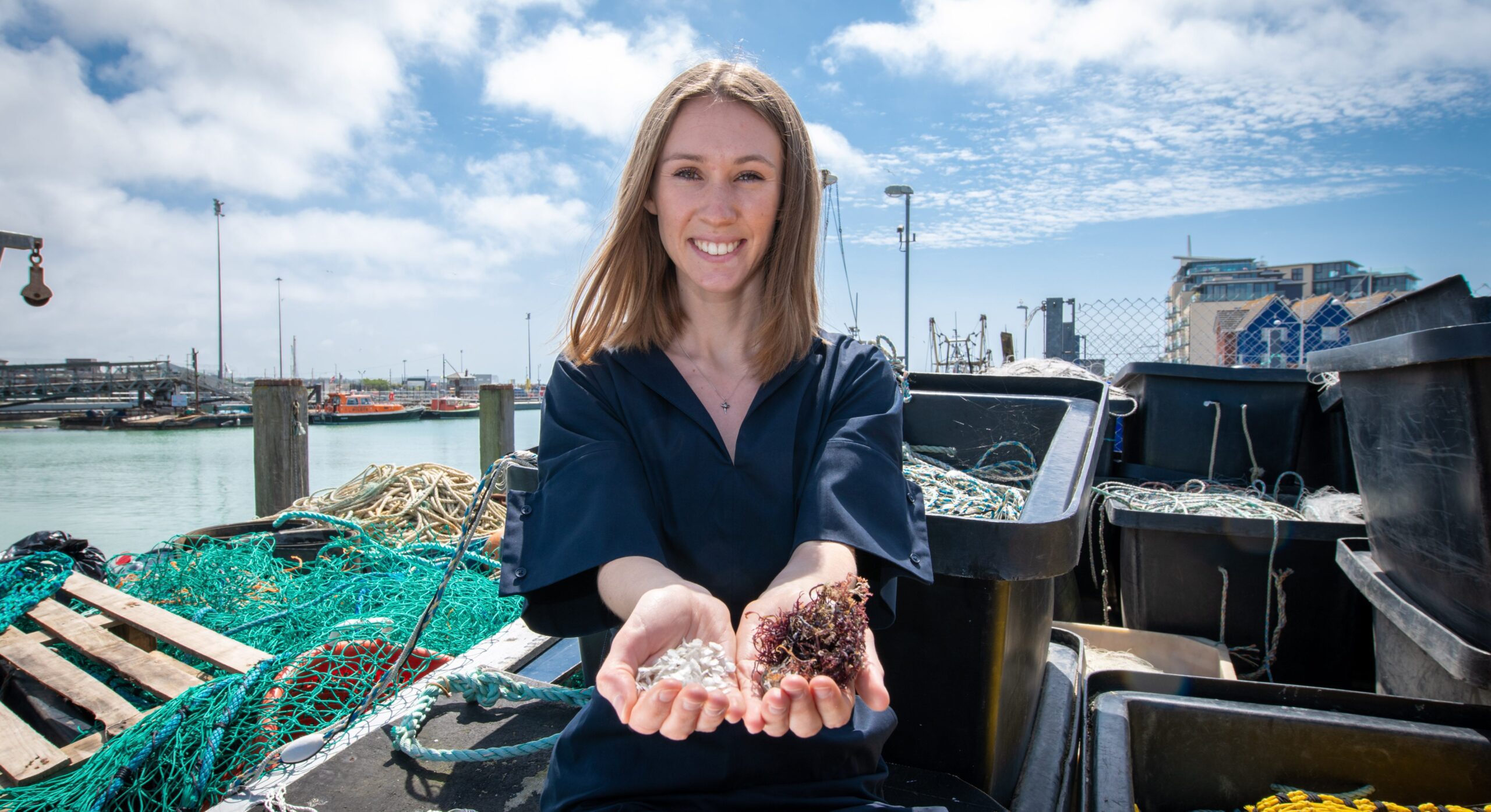


This week, we spoke to founder of MarinaTex Lucy Hughes about her amazing fish waste based plastic alternative. Lucy recently won the International James Dyson Award for her invention, which has the potential to solve both the problems of fish waste and single-use plastics.
Hi Lucy! Congratulations on the award! I understand your invention began as part of a university assignment. What was the task the university assigned you?
The assignment was the final year project for my undergraduate degree. Product Design students have a year to apply what they have learnt from the previous years and develop a product that solves a problem. I wrote my own brief around utilising waste from the fishing industry.
How did you come up with the idea in the first place?
My project began with the notion that there is value is waste and waste is resource in the wrong place. I then let the research forge the path of the project.
Where did the idea of utilising fish waste come from?
Through a university lecturer, I was put in contact with MCB Seafoods, a fish wholesalers and processing plant.I got a tour of the plant where I was introduced to the different waste streams, e.g.bones, offal, skins and scales. It was ultimately the skins and scales that captured my imagination due to their strength and flexibility.

© Lucy Hughes, MarinaTex
Where did you make and design the product?
In my kitchen of my student house through over 100 process and composition experiments!
Does the product smell like fish?
It absolutely does not!
Do you think the product will be available to purchase any time soon?
The material needs further research and development. Due to the nature of R&D, exact time frames are hard to conjure. I’d love to see it available in under 3 years.
Who would the target market be for the product?
There are different target markets for this product, however my main focus is on packaging distributors that provide for supermarkets, cafes and travel terminals.
How much would the product cost if it were to be put on the market? How much does it cost to make?
Due to the project being in its infancy, it is hard to give an exact figure of production cost. Initial estimates have put it as a similar cost to plastic due to the low energy intensive process and utilising a waste product.
Can you explain why it’s so important to have a plastic alternative?


Plastic is an amazing material, however we have grown overly dependent upon it and it has been used in invaluable places. This dependency and throw away culture has had severe effects on the environment from damaging wildlife to food chain contamination.
I would always champion refusing and reusing existing products above any other alternative. However, there are some places that the benefits of plastic can’t be refused or reused. In these cases, finding planet conscious alternatives is imperative.

© Lucy Hughes, MarinaTex
Where do you see yourself and your product over the next decade?
In an ideal world, in ten years MarinaTex will be developed to a point where it can provide an effective* alternative to applications that still can’t refuse plastic. I would hope in ten years the high-street consumption of single-use plastic will have reduced because of behaviour change and government regulations.
*Effective = cost effective, regenerative and planet conscious.
Are there any other similar products on the market that companies/people could use in the meantime while your idea is being developed?
There are bio-plastics already on the market, predominantly ones made from corn-starch. These are labelled ‘biodegradable’, however this labelling is misleading for those who don’t spend their evenings researching government standards for biodegradability!
It should be understood that biodegradable and compostable are related but different. Most corn-starch bio-plastics need high temperature industrial composting facilities to break down and very few cities have the infrastructure needed to deal with them. As a result, bio-plastics often end up in landfills where, deprived of oxygen, they may release methane, a greenhouse gas 23 times more potent than carbon dioxide.
In the meantime, I would encourage individuals to vote with their money to endorse products and businesses that are planet conscious and reuse what they already own. Know that as a consumer you have power!
Thanks so much for talking to us, Lucy, that was really interesting! We can’t wait to see MarinaTex in supermarkets and elsewhere in the near future. Good luck with everything!
If, like us, you’re intrigued, you can find out more about Lucy’s invention on the MarinaTex website.
Featured image: © Lucy Hughes, MarinaTex.